


Your cart is empty

In this article
Key points
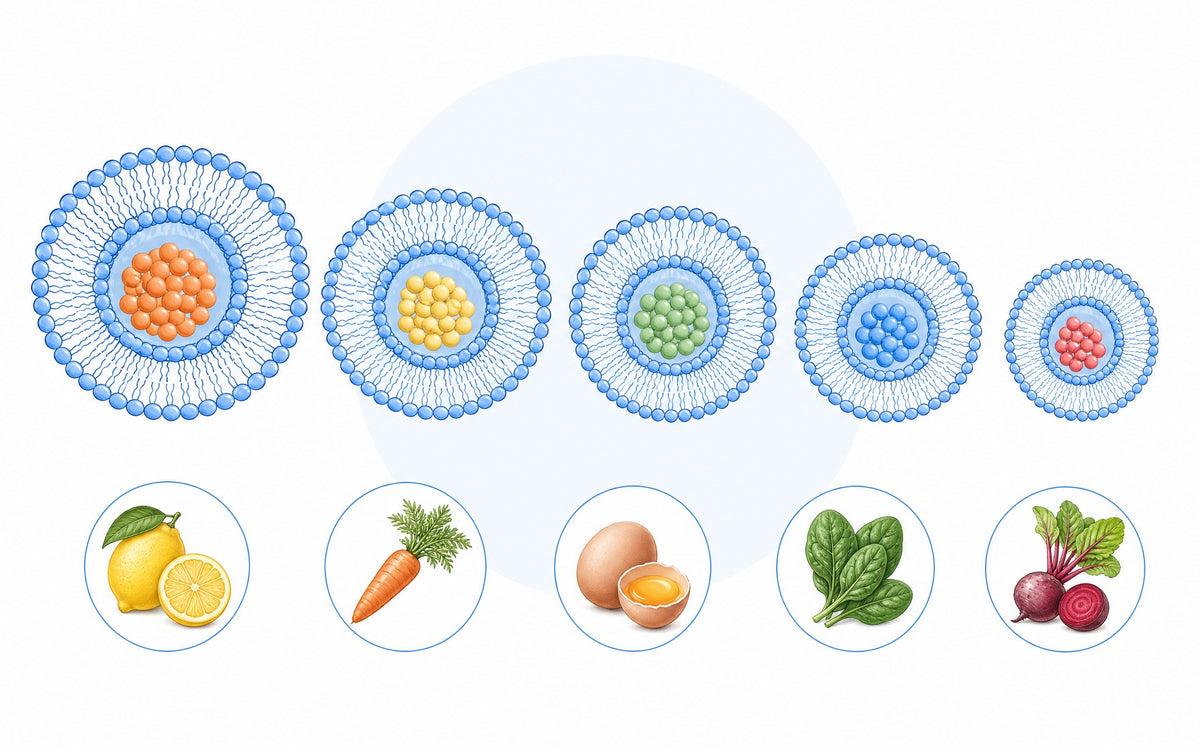
- Liposomal means the nutrient is enclosed in liposomes: tiny vesicles with a shell made of phospholipids.
- Water-soluble nutrients such as vitamin C sit in the watery core, while fat-soluble ones sit in the shell.
- The shell is intended to protect what’s inside on its way through the digestive tract. For vitamin C and iron, studies of liposomal forms measured higher levels in the blood.
- Liposomal describes how the nutrient is packaged, not the dosage form: there are liposomal drops and liposomal capsules.
What does liposomal mean?
The word ‘liposomal’ tells you that a nutrient is held inside liposomes. The name comes from the Greek words for fat (lipos) and body (soma).
Liposomes are tiny spheres whose shell is made of one or more double layers of phospholipids, known as bilayers. They were first described in the mid-1960s1.
So when you see ‘liposomal’ on a pack, it doesn’t mean there’s a different ingredient inside. Vitamin C is still vitamin C, and iron is still iron: only the packaging is different. You’ll find more detail in our article on what liposomes are.
How is a liposome put together?
Phospholipids have a head that’s attracted to water and two fatty-acid tails that repel it. In water, they therefore line up in a double layer, with the heads facing the water and the tails facing each other. When this layer closes into a sphere, it forms a liposome with a watery core.
This structure makes liposomes versatile. They can carry both water-soluble and fat-soluble substances2: water-soluble ones such as vitamin C fit into the core, and fat-soluble ones such as vitamin D into the shell. You can read more about what they’re made of in our article on phospholipids.
Liposomes aren’t the only carriers of this kind. Micelles, for example, have just a single layer and no watery core. Our article on micellar versus liposomal forms explains how the two differ.
Why are nutrients packed into liposomes?
On its way into the blood, a nutrient has to get through the stomach and gut. Liposomes have a shell that resembles the body’s own cell membranes3. According to a review, for substances the body otherwise absorbs poorly, enclosing them in liposomes can increase their bioavailability4.
To carry their contents through the digestive tract, liposomes have to stay stable there. How well that works depends on the composition and structure of the shell3. That’s why it’s worth looking at the studies for each nutrient individually.
What does liposomal mean for vitamin C, iron and magnesium?
Vitamin C
Vitamin C is water-soluble, so it sits in the watery core. A review found ten human studies that compared liposomal with conventional vitamin C, and in nine of them blood levels were higher with the liposomal form5.
The studies looked at very different formulations and amounts, and mostly measured the level in the blood5. What the vitamin itself does in the body is described by an authorised health claim: ‘Vitamin C contributes to the normal function of the immune system’.
Iron
In liposomal iron, the mineral is enclosed in liposomes. In a study of 25 healthy adults, blood iron levels rose more after a liposomal multivitamin and mineral product than after a standard product with the same dose6. However, the study was small, followed participants for only six hours after a single dose, and advisers to the study’s sponsor took part in the lab analyses and in interpreting the results6. A blood test shows whether you need iron, so ask your doctor to check.
Magnesium
With magnesium, too, the mineral is held in liposomes. Liposomal magnesium comes as a liquid that’s easy to measure out precisely, and as capsules, which have no taste and are handy on the go. Magnesium contributes to a reduction of tiredness and fatigue. Our comparison of magnesium forms shows how citrate, bisglycinate and other forms differ.
How to recognise a liposomal product
A liposomal product contains phospholipids, often in the form of lecithin, and you’ll find them in the ingredients list. Liposomal describes the packaging, not the dosage form: there are liposomal drops as well as liposomal capsules, as we explain in our article on liposomal forms and capsules. For what else to look out for when buying, see our guide to recognising a good liposomal product.
Our liposomal products are manufactured to European pharmaceutical quality.
Frequently asked questions about the term ‘liposomal’
What is the liposomal form?
The liposomal form describes how a nutrient is packaged: in liposomes made of phospholipids. It doesn’t change the nutrient itself. How much to take each day is stated on the label. Do not exceed the recommended daily amount.
What is liposomal quercetin?
Quercetin is a plant compound from the flavonoid group. It dissolves poorly in water and has low bioavailability7. Liposomes are among the carrier systems researchers are using to try to improve its solubility and bioavailability7. You can read more about the compound in our article on what quercetin is.
What is liposomal iron?
Liposomal iron is iron enclosed in liposomes. Some products also contain vitamin C, because vitamin C increases iron absorption. Our article on taking vitamin C and iron together explains how to combine the two.
Sources
- Akbarzadeh A, Rezaei-Sadabady R, Davaran S, et al. (2013). Liposome: classification, preparation, and applications. Nanoscale Research Letters 8(1):102. DOI
- Mankan E, Karakas CY, Saroglu O, Mzoughi M, Sagdic O, Karadag A (2025). Food-Grade Liposome-Loaded Delivery Systems: Current Trends and Future Perspectives. Foods 14(17):2978. DOI
- He H, Lu Y, Qi J, Zhu Q, Chen Z, Wu W (2019). Adapting liposomes for oral drug delivery. Acta Pharmaceutica Sinica B 9(1):36-48. DOI
- Rudzińska M, Grygier A, Knight G, Kmiecik D (2024). Liposomes as Carriers of Bioactive Compounds in Human Nutrition. Foods 13(12):1814. DOI
- Carr AC (2025). Do Liposomal Vitamin C Formulations Have Improved Bioavailability? A Scoping Review Identifying Future Research Directions. Basic & Clinical Pharmacology & Toxicology 137(1):e70067. DOI
- Tinsley GM, Harty PS, Stratton MT, Siedler MR, Rodriguez C (2022). Liposomal Mineral Absorption: A Randomized Crossover Trial. Nutrients 14(16):3321. DOI
- Cai X, Fang Z, Dou J, Yu A, Zhai G (2013). Bioavailability of Quercetin: Problems and Promises. Current Medicinal Chemistry 20(20):2572-2582. DOI
This article is for general information only and should not replace medical advice. Food supplements are not a substitute for a balanced and varied diet and a healthy lifestyle.
Written by
Melinava Editorial Team