
Your cart is empty

In this article
- Key points
- When is blood pressure considered high?
- What causes high blood pressure?
- How to lower high blood pressure: what do salt, weight and exercise achieve?
- Omega-3 and blood pressure: what do studies show?
- Which foods contain omega-3?
- What about blood pressure medicines?
- Frequently asked questions about high blood pressure
- Sources
Key points at a glance
- The main things you can do yourself to lower high blood pressure are cutting down on salt, losing weight if you’re overweight, and exercising regularly. In studies, each of these steps brought blood pressure down by a few mmHg1,2,3.
- Prescribed blood pressure medicines are part of the picture. Many people still need them, even with a healthier lifestyle4.
- In studies, omega-3 lowered blood pressure slightly, most clearly at 2 to 3 g of EPA and DHA a day5. The authorised health claim on blood pressure only applies from 3 g a day6.
- For heart function, 250 mg of EPA and DHA a day is enough, according to the authorised health claim6.
Around one in three adults aged 30 to 79 worldwide has high blood pressure4. Almost half of them don’t know it, because raised blood pressure usually causes no symptoms4. The good news is that if you want to lower your blood pressure, there are several everyday changes you can make, and their effect has been well studied.
44%
of adults with high blood pressure don’t know they have it4.
5.4 mmHg
fall in the top number (systolic) in people with high blood pressure who ate 4.4 g less salt a day1.
When is blood pressure considered high?
Blood pressure is given as two numbers. The top number (systolic) shows the pressure in your blood vessels when your heart beats, and the bottom number (diastolic) shows the pressure in the pause between two beats4. High blood pressure is diagnosed when, on two different days, the top number is 140 mmHg or more or the bottom number is 90 mmHg or more4.
Most people with high blood pressure feel nothing at all4. The only way to find out is to measure it, so it’s worth having your blood pressure checked regularly4. Left untreated, high blood pressure can lead to heart disease, kidney disease and stroke4.
What causes high blood pressure?
Some risk factors are within your control and some aren’t4. The ones you can change are eating a lot of salt, eating too little fruit and veg, eating a lot of saturated fat, doing too little exercise, being overweight, smoking and drinking alcohol4. The ones you can’t change are being over 65, high blood pressure in the family, and other conditions such as diabetes or kidney disease4.
How to lower high blood pressure: what do salt, weight and exercise achieve?
Less salt
A systematic review brought together 34 studies with 3,230 participants, who ate on average 4.4 g less salt a day for at least four weeks1. In people with high blood pressure, the top number fell by 5.4 mmHg on average and the bottom number by 2.8 mmHg1. The more salt intake fell, the further the top number dropped1.
Losing weight if you’re overweight
An analysis of 25 studies with 4,874 participants found that for every kilogram of body weight lost, the top number fell by about 1 mmHg2. In studies where participants lost more than 5 kg on average, the top number was 6.6 mmHg lower2. The weight came off through eating fewer calories, exercising more, or both2.
Regular exercise
In an analysis of 93 studies, endurance exercise lowered the top number by 3.5 mmHg on average3. The difference was greater in people with high blood pressure: on average 8.3 mmHg for the top number and 5.2 mmHg for the bottom number3. Strength training lowered blood pressure too3. The World Health Organization (WHO) recommends at least 150 minutes of moderate endurance activity a week, plus muscle-strengthening activity on two or more days4.
Omega-3 and blood pressure: what do studies show?
EPA and DHA are long-chain omega-3 fatty acids. An analysis of 71 studies with 4,973 participants looked at how much blood pressure fell depending on the amount taken5. The amounts were mostly between 1.3 and 3.6 g of EPA and DHA a day5. Blood pressure fell most clearly at 2 to 3 g a day: the top number by about 2.6 mmHg and the bottom number by 1.6 to 1.8 mmHg5.
The effect was stronger in people with high blood pressure, in people with raised blood fats and in older people5. Overall, the difference is fairly small, and it depends on the amount. Our article on how to read the evidence from studies explains how to judge research of this kind.
There is an authorised health claim for blood pressure: ‘DHA and EPA contribute to the maintenance of normal blood pressure’6. However, it may only be used for food which provides a daily intake of 3 g of EPA and DHA6. From food supplements, your total intake should not exceed 5 g of EPA and DHA combined a day6. Talk to your doctor before taking amounts like these, especially if you take any medicines.
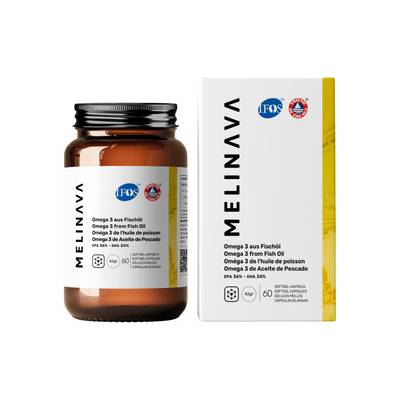
For heart function, the amount needed is lower: ‘EPA and DHA contribute to the normal function of the heart’, and the beneficial effect is obtained with a daily intake of 250 mg of EPA and DHA6. This claim is about the heart, not blood pressure. Our Omega 3 from fish oil meets this condition at the recommended daily amount. Do not exceed the recommended daily amount.
Which foods contain omega-3?
Oily cold-water fish such as salmon, mackerel, herring, tuna and sardines provide plenty of EPA and DHA7. These fatty acids are originally made by microalgae, and fish take them in through the food chain7. Plant oils such as linseed oil and rapeseed oil contain a different omega-3 fatty acid, ALA. Studies that measured this show that the body converts only a small part of it, less than 15%, into EPA and DHA7.
What about blood pressure medicines?
Many people still need medicines, even with a healthier lifestyle4. Take your prescribed medicines as agreed with your doctor and keep your check-up appointments4. Lifestyle changes add to your treatment; they don’t replace it. If you take any medicines, check with your doctor before starting a food supplement.
A home blood pressure monitor can help you keep track of how your readings change over time. But assessing your readings and your overall risk is a job for your doctor4.
Frequently asked questions about high blood pressure
What are the symptoms of high blood pressure?
Usually none at all4. Very high readings, usually from about 180/120 mmHg, can cause a severe headache, chest pain, dizziness, shortness of breath or problems with your vision4. If you have symptoms like these together with high blood pressure, get medical help straight away4.
How quickly can high blood pressure be lowered?
In the studies on salt and exercise, the programmes ran for at least four weeks1,3. So expect weeks rather than days. Measuring regularly shows you how your readings are changing.
What does omega-3 do?
EPA and DHA contribute to the normal function of the heart, from 250 mg of EPA and DHA a day6. DHA contributes to maintenance of normal brain function, and DHA contributes to the maintenance of normal vision, from 250 mg of DHA a day6. For blood pressure, the claim only applies from 3 g of EPA and DHA a day6. You can read more about the study people often mention in our article Omega-3: what’s behind the Zurich study.
Sources
- He FJ, Li J, MacGregor GA (2013). Effect of longer term modest salt reduction on blood pressure: Cochrane systematic review and meta-analysis of randomised trials. BMJ 346:f1325. DOI
- Neter JE, Stam BE, Kok FJ, Grobbee DE, Geleijnse JM (2003). Influence of weight reduction on blood pressure: a meta-analysis of randomized controlled trials. Hypertension 42(5):878-884. DOI
- Cornelissen VA, Smart NA (2013). Exercise training for blood pressure: a systematic review and meta-analysis. Journal of the American Heart Association 2(1):e004473. DOI
- Weltgesundheitsorganisation (2025). Hypertension. Fact sheet. Link
- Zhang X, Ritonja JA, Zhou N, Chen BE, Li X (2022). Omega-3 Polyunsaturated Fatty Acids Intake and Blood Pressure: A Dose-Response Meta-Analysis of Randomized Controlled Trials. Journal of the American Heart Association 11(11):e025071. DOI
- European Commission (2012). Commission Regulation (EU) No 432/2012 of 16 May 2012 establishing a list of permitted health claims made on foods, other than those referring to the reduction of disease risk and to children’s development and health (consolidated version of 17 May 2021). Link
- National Institutes of Health, Office of Dietary Supplements (2025). Omega-3 Fatty Acids: Fact Sheet for Health Professionals. Link
This article is for general information only and should not replace medical advice. Food supplements are not a substitute for a balanced and varied diet and a healthy lifestyle.
Written by
Melinava Editorial Team