

Your cart is empty

In this article
The key points at a glance
- Phospholipids are fat-like molecules with a head that’s attracted to water and two tails that avoid it.
- In water, they line up into a double layer, known as a bilayer. Cell membranes and liposomes are made of layers like these.
- For foods and supplements, they’re obtained from sources such as soybeans, sunflowers or egg yolk, often in the form of lecithin.
- In the EU, lecithin is authorised as the food additive E 322, and EFSA found no safety concerns for its reported uses.
What are phospholipids?
Phospholipids belong to the lipids, the group that covers fats and fat-like substances. What sets them apart is their structure: they’re amphiphilic, which means one side is attracted to water and the other to fat1. The head carries a phosphate group and is water-loving. Attached to it are two fatty-acid tails that avoid water.
Different phospholipids are told apart by the group that sits on the head. Lecithin isn’t a single substance but a mixture. Plant lecithin contains phosphatidylcholine, phosphatidylethanolamine and phosphatidylinositol, among others2.
How does a bilayer form?
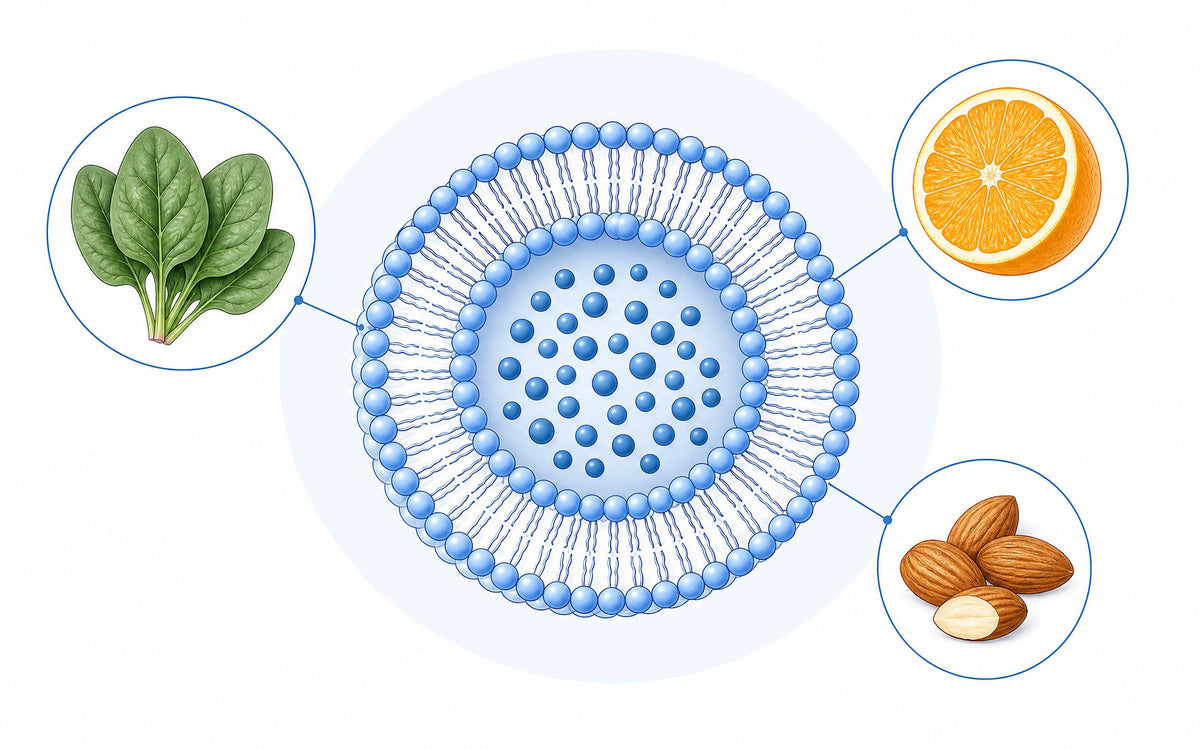
In water, phospholipids arrange themselves on their own: the heads turn towards the water and the tails tuck away inside. The result is a bilayer, a double layer that’s water-loving on its outer and inner surfaces and fat-loving in the middle. It’s this ability to assemble without any outside help that makes phospholipids so useful, both in nature and in manufacturing.
The cell membrane that surrounds every cell is built on the same principle. At its core, it’s a lipid bilayer3. Its fat-loving inner part is only about 3 nanometres thick (three millionths of a millimetre), and it separates the inside of the cell from its surroundings3.
Where are phospholipids found?
Because every cell has a membrane, phospholipids are found in both plant and animal foods. Important sources include eggs, dairy products, vegetable oils and marine oils1. In terms of quantity, they make up only a small proportion of the fat in food, but they play important roles1.
In the EU, lecithin is authorised as the food additive E 3224. When EFSA re-evaluated it in 2017, it didn’t consider a numerical acceptable daily intake (ADI) necessary, and for the uses reported to it, it found no safety concern for the general population aged one year and over4. As an emulsifier, lecithin allows fat and water to mix.
Phospholipids from soybeans or sunflowers?
For medicines, natural phospholipids are obtained from sources such as soybeans or egg yolk5. Sunflowers and other oilseeds also provide lecithin. Plant lecithins like these are increasingly in demand as natural, non-allergenic emulsifiers2.
Their composition varies with the source, for example in the proportion of phosphatidylcholine2. For consumers, though, another point often matters more: soy is one of the allergens that must be highlighted in the ingredient list. So if you want to avoid soy, check the label for where the phospholipids come from.
Plant lecithin is obtained when crude vegetable oil is refined. In the process, the phospholipids are separated from the oil, processed and, depending on their intended use, purified further. For supplements, consistent quality matters, so that the liposomes in every batch behave the same way.
How liposomes are made from phospholipids
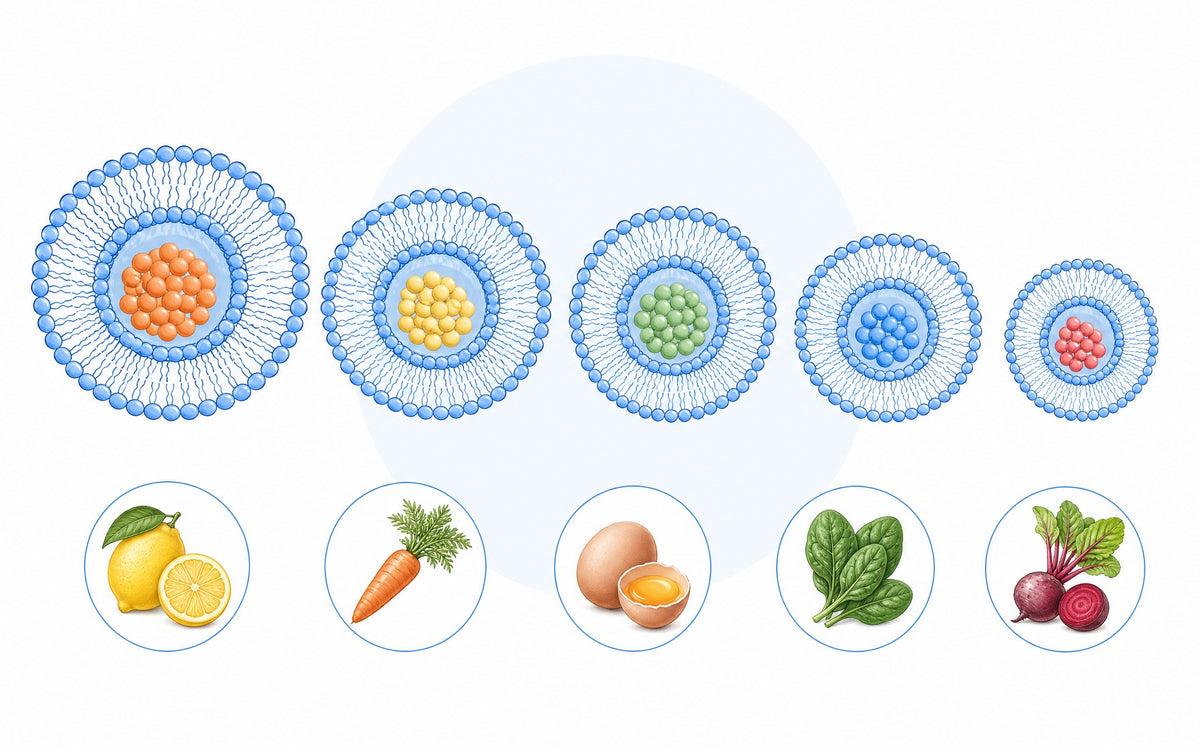
When a phospholipid bilayer closes up into a sphere, the result is a liposome. Liposomes are spherical vesicles made of one or more of these bilayers6. They can carry ingredients both in their watery core and in their fat-loving shell.
Natural phospholipids are used in oral products and in skincare products, including in the form of liposomes5. You can read how liposomes are structured and what happens to them in the digestive tract in our article ‘What are liposomes?’. The role they play in creams and sprays is covered in ‘Liposomes in creams, gels and sprays’.
For our liposomal products, we use phospholipids from European sunflowers, and the liposomes are made from them.
Frequently asked questions about phospholipids
Phospholipids as a food supplement: what do we know?
Phospholipids from soy, egg yolk, milk and marine sources have been studied for possible effects. A 2012 review noted that most of the studies had been carried out in the laboratory or in animals, and that evidence of a benefit in humans was limited7. In liposomal supplements, phospholipids mainly form the shell around the main ingredient.
Soy phospholipids: what should you look out for?
Lecithin, including soy lecithin, is authorised as an additive in the EU, and EFSA found no safety concerns for its reported uses4. If you need to avoid soy, check the ingredient list, because soy must be highlighted there.
How are phospholipids structured?
A phospholipid has a water-loving head with a phosphate group and two fat-loving fatty-acid tails. That’s why diagrams often draw it as a circle with two legs: the head seeks out the water, and the legs point away from it. It’s this structure that makes phospholipids arrange themselves into bilayers in water.
Sources
- Bahi A, Ranneh Y, Alyammahi MSO, Alnuaimi MFH, Platat C, Fadel A (2026). Analytical challenges and opportunities in the extraction, separation, and identification of food phospholipids. Frontiers in Nutrition 13:1743161. DOI
- Harasym J, Wójcik W (2026). Lecithin Characteristics from Niche Oils. Molecules 31(13):2274. DOI
- van Meer G, Voelker DR, Feigenson GW (2008). Membrane lipids: where they are and how they behave. Nature Reviews Molecular Cell Biology 9(2):112-124. DOI
- EFSA Panel on Food Additives and Nutrient Sources added to Food (ANS), Mortensen A, Aguilar F, et al. (2017). Re-evaluation of lecithins (E 322) as a food additive. EFSA Journal 15(4):e04742. DOI
- van Hoogevest P, Wendel A (2014). The use of natural and synthetic phospholipids as pharmaceutical excipients. European Journal of Lipid Science and Technology 116(9):1088-1107. DOI
- Akbarzadeh A, Rezaei-Sadabady R, Davaran S, et al. (2013). Liposome: classification, preparation, and applications. Nanoscale Research Letters 8(1):102. DOI
- Küllenberg D, Taylor LA, Schneider M, Massing U (2012). Health effects of dietary phospholipids. Lipids in Health and Disease 11(1):3. DOI
This article is for general information only and should not replace medical advice. Food supplements are not a substitute for a balanced and varied diet and a healthy lifestyle.
Written by
Melinava Editorial Team