

Your cart is empty

In this article
- Key points
- Where does the idea of ‘liposomal versus capsules’ come from?
- Two terms, two levels
- How do liposomes get into a capsule?
- What studies with liposomal capsules have measured
- Capsules or liquid: which suits you?
- Liposomal or capsules? Our verdict: a false choice
- Frequently asked questions about liposomes and capsules
- Sources
Key points at a glance
- ‘Liposomal or capsules’ isn’t an either-or question: ‘liposomal’ describes how an ingredient is packaged, ‘capsule’ describes the form you take it in.
- Liposomes come in liquids, but also in dried form as a powder, and that powder can be filled into capsules.
- In the studies that measured higher blood levels of vitamin C and coenzyme Q10 with liposomal forms, the participants were given capsules.
- Our verdict: the supposed choice between the two is a false one. Which form suits you depends mainly on your daily routine and your preferences.
Where does the idea of ‘liposomal versus capsules’ come from?
In online shops and search results, ‘liposomal’ and ‘capsules’ often appear side by side, as if you had to pick one or the other. Many people picture a liposomal product as a liquid in a small bottle, and a capsule as an ordinary powder in a shell. Both assumptions fall short, because the two terms describe different things.
Two terms, two levels
The dosage form is the way you take a product. For food supplements, EU law names capsules, tablets, sachets of powder and bottles with a dropper, among others1.
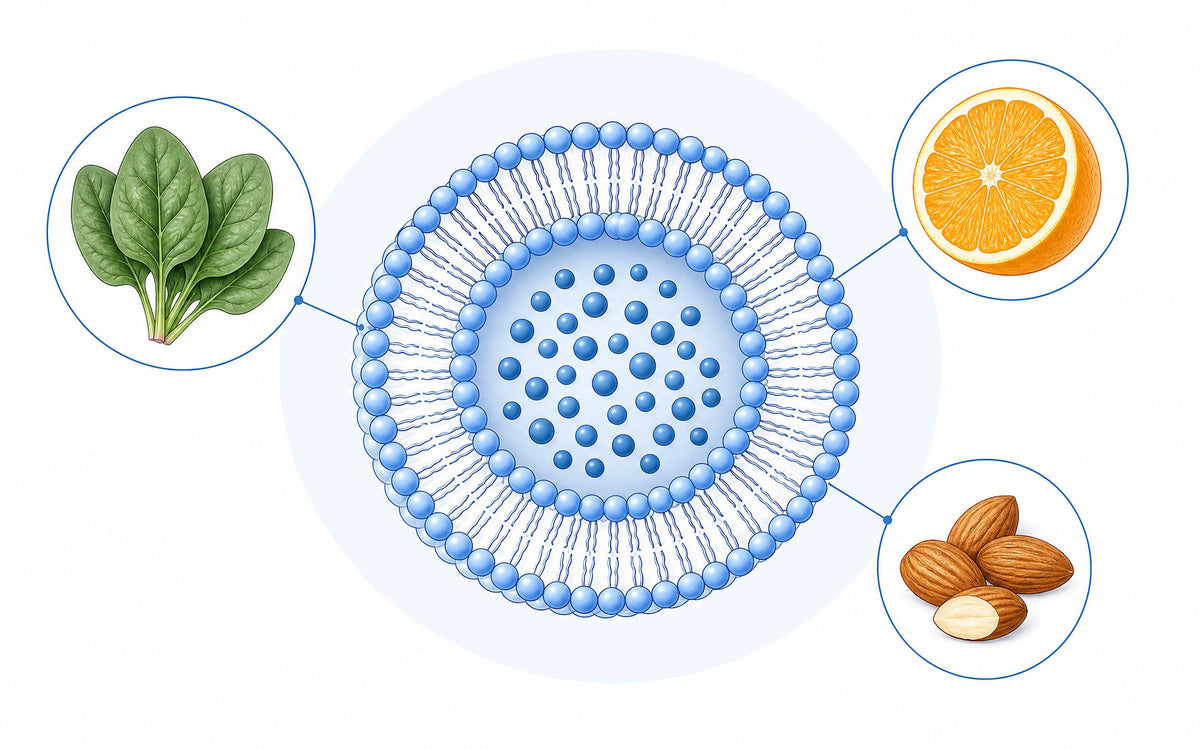
‘Liposomal’, on the other hand, describes how the ingredient is packaged: in tiny vesicles made of phospholipids, whose outer layer resembles the membranes of our own cells. Water-soluble substances sit inside the vesicles, fat-soluble ones in their outer layer2. So a liposomal ingredient can come in a liquid or in a capsule, just like a conventional one. You can find out more about what liposomes are made of in our article on phospholipids.
How do liposomes get into a capsule?
For a capsule with a powder filling, the liposomes are dried first, for example by freeze-drying. Researchers regard freeze-drying as a promising way to keep liposomes stable over a long period3. To keep the vesicles stable while they dry, protective substances are added, and the formulation and the process are carefully matched to each other3.
Whether liquid or dried, liposomes have to withstand stomach acid, bile salts and digestive enzymes on their way through the stomach and intestines2. That’s why careful formulation and good manufacturing matter for both forms.
What studies with liposomal capsules have measured
Several studies have measured directly whether a liposomal capsule gets more of an ingredient into the blood than a conventional one. In a study of 27 healthy adults, each participant took 500 mg of vitamin C, once in a conventional capsule and once in a liposomal capsule. With the liposomal capsule, the peak level in blood plasma was 27% higher, and 21% higher when calculated over 24 hours4.
A study of 18 adults followed the same design, comparing 100 mg of coenzyme Q10 in a conventional and a liposomal capsule. With the liposomal capsule, the peak level in the blood was 31% higher, and 23% higher when calculated over 24 hours5. Both studies, on vitamin C and on coenzyme Q10, were funded by the manufacturer of the formulation being tested4,5.
27%
higher peak level of vitamin C in blood plasma with the liposomal capsule4
31%
higher peak level of coenzyme Q10 in the blood with the liposomal capsule5
A review of liposomal vitamin C also describes a study of 14 adults in which the same liposomal formulation was tested as a tablet and as a capsule. There was no difference between the tablet and the capsule, and both gave markedly higher blood levels than the conventional form6.
Capsules or liquid: which suits you?
As both forms can be liposomal, other factors come into play day to day:
- Capsules have no taste, come in precise amounts and are easy to carry.
- Liquids let you adjust the amount in small steps and suit people who don’t like swallowing capsules.
- What matters most is that you’re happy to take your chosen form, and that you take it regularly.
Our article on drops, capsules or powder and which form suits you looks at further differences between the forms. The studies above were carried out with formulations from other manufacturers, not with Melinava products.
Liposomal or capsules? Our verdict: a false choice
‘Liposomal or capsules’ sounds like a choice, but it isn’t one. ‘Liposomal’ describes how the ingredient is packaged, the capsule describes how you take it, and the two can be combined. Indeed, the studies that found higher blood levels of vitamin C and coenzyme Q10 used liposomal capsules4,5. For our liposomal products, we use phospholipids from European sunflowers.
Frequently asked questions about liposomes and capsules
Is there liposomal vitamin C in capsule form?
Yes. Dried liposomes can be filled into capsules, and a study of 27 adults looked at a liposomal vitamin C capsule4. Check how much each capsule contains. Do not exceed the recommended daily amount.
Ashwagandha: liposomal or capsules?
Here too, it’s not one or the other: liposomal ashwagandha extract is available both as a liquid and in capsules. Choose according to taste, dosing and your daily routine. You can read about the root itself in our article on ashwagandha and KSM-66.
Astaxanthin: liposomal or capsules?
Astaxanthin is fat-soluble. In a liposome, fat-soluble substances sit in the outer layer of the vesicle, whether the product is a liquid or a capsule2. There’s more on this in our article on astaxanthin and why it’s taken in liposomal form.
Sources
- European Parliament and Council of the European Union (2002). Directive 2002/46/EC of the European Parliament and of the Council of 10 June 2002 on the approximation of the laws of the Member States relating to food supplements. Link
- He H, Lu Y, Qi J, Zhu Q, Chen Z, Wu W (2019). Adapting liposomes for oral drug delivery. Acta Pharmaceutica Sinica B 9(1):36-48. DOI
- Chen C, Han D, Cai C, Tang X (2010). An overview of liposome lyophilization and its future potential. Journal of Controlled Release 142(3):299-311. DOI
- Purpura M, Jäger R, Godavarthi A, Bhaskarachar D, Tinsley GM (2024). Liposomal delivery enhances absorption of vitamin C into plasma and leukocytes: a double-blind, placebo-controlled, randomized trial. European Journal of Nutrition 63(8):3037-3046. DOI
- Jäger R, Purpura M, Godavarthi A, et al. (2025). Impact of liposomal delivery on coenzyme Q10 absorption: a double-blind, placebo-controlled, randomized trial. Frontiers in Nutrition 12:1605033. DOI
- Carr AC (2025). Do Liposomal Vitamin C Formulations Have Improved Bioavailability? A Scoping Review Identifying Future Research Directions. Basic & Clinical Pharmacology & Toxicology 137(1):e70067. DOI
This article is for general information only and should not replace medical advice. Food supplements are not a substitute for a balanced and varied diet and a healthy lifestyle.
Written by
Melinava Editorial Team