

Your cart is empty

In this article
The key points at a glance
- Micellar curcumin is held in micelles, tiny spheres made of a single layer of emulsifiers. In liposomal curcumin, the curcumin sits in the shell (membrane) of tiny vesicles made of phospholipids.
- Both forms are designed to compensate for two things: curcumin barely dissolves in water, and only a small amount of it reaches the blood.
- The difference lies in the structure: liposomes have room for fat-soluble and water-soluble substances at the same time, while micelles are mainly suited to fat-soluble ones.
- Studies on both forms measured how much curcumin reaches the blood, each with one specific formulation. There is no authorised health claim for curcumin.
If you’re reading up on curcumin, you’ll soon come across two terms: micellar and liposomal. Both sound technical, but they simply describe how the curcumin is packaged. Here we explain, step by step, what they mean and how the two forms differ.
Why is curcumin enclosed in micelles or liposomes?
Curcumin is the yellow pigment in turmeric root1. For the difference between turmeric, curcumin and piperine, see our article turmeric, curcumin and piperine: what’s what?
Curcumin barely dissolves in water, is chemically unstable and is quickly metabolised in the body. As a result, only a small part of the curcumin you swallow reaches the blood1. To get round these hurdles, at least in part, manufacturers enclose curcumin in tiny particles. Micelles and liposomes are among the most common, and each technique has its own strengths and limitations1.
What ‘micellar’ means
Micellar means packaged in micelles. A micelle is a tiny sphere made of a single layer of emulsifiers, and it forms by itself when these substances are dissolved in water. The emulsifiers’ fat-loving ends point inwards and their water-loving ends outwards, with the curcumin sitting in the fatty interior1.
Most of the emulsifiers used are synthetic, although natural ones exist too, such as the milk protein casein1. Micelles are so small that micellar liquids usually look clear1. As a micelle has no watery core, it is mainly suited to fat-soluble substances.
Liposomal: what’s different?
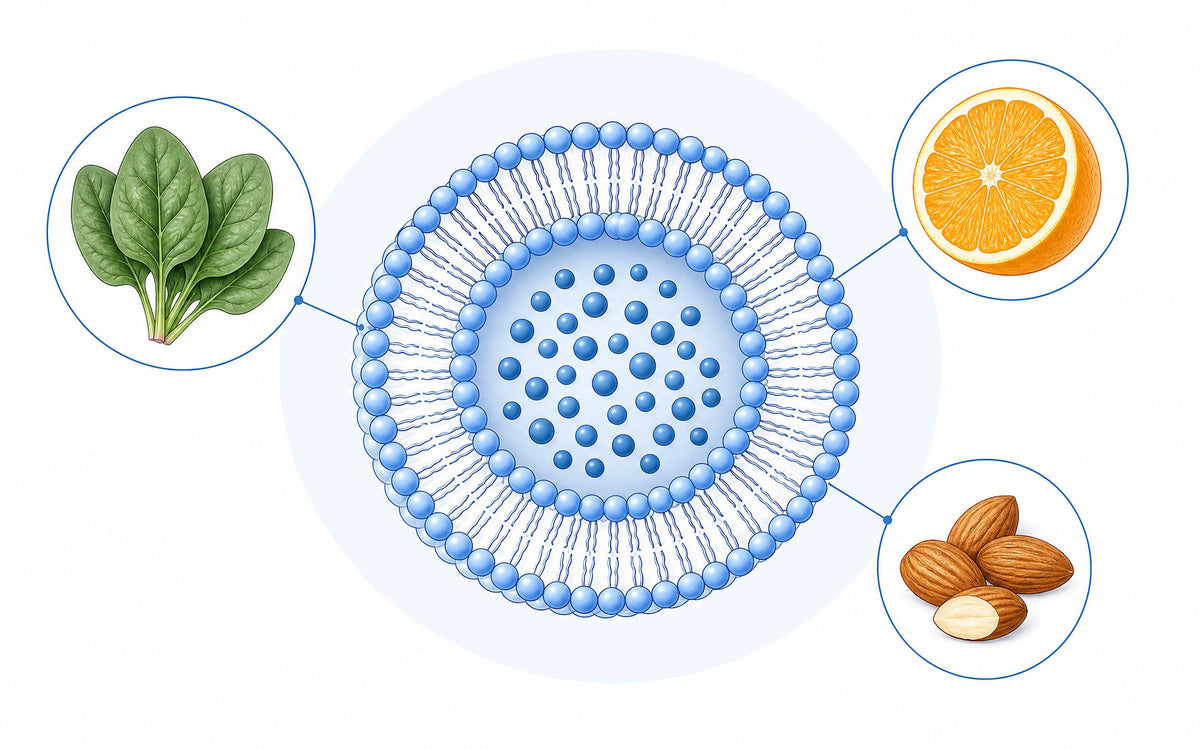
A liposome is a tiny vesicle whose shell is made of one or more double layers (bilayers) of phospholipids. Its structure is therefore similar to the membranes of our own cells1. Fat-soluble substances such as curcumin fit into the shell, and water-soluble ones into the watery core.
A liposome therefore has areas for both water-loving and fat-loving substances. This can be useful when a product is meant to combine several substances with different properties in one system1. You’ll find more about the structure in our article what are liposomes?
What the studies have measured
For micellar curcumin, there is a study in 23 healthy adults. After they took a micellar liquid, the amount of curcumin in their blood over 24 hours was markedly higher than after conventional curcumin powder. Women absorbed more curcumin than men2.
For liposomal curcumin, there is a double-blind study in 18 healthy men. The group given the liposomal formulation received only one fifth as much curcumin as the comparison group, who took conventional curcumin. Even so, the liposomal group reached a markedly higher peak level in the blood3.
Both studies were small and tested a single dose of one specific formulation. Because the formulations, amounts and participants differed, the two results can’t be compared with each other. Claims such as ‘absorbed x times better’ therefore only ever apply to the formulation that was tested. They also depend on how the measurement was made: many studies measure curcumin including its bound (conjugated) forms in the body, and a review has criticised this widespread method4.
Good to know: There is no authorised health claim for curcumin in the UK or the EU. The studies mentioned measured blood levels, not how the participants felt. They were carried out with formulations from other manufacturers.
Micellar or liposomal: how to choose
Both forms have the same aim but differ in structure and ingredients. These questions will help you choose.
- Ingredients: micelles are mostly made from synthetic emulsifiers, liposomes from phospholipids like those found in the membranes of our cells. The ingredients list shows exactly what’s inside.
- Combination: if the product is meant to contain water-soluble substances as well as curcumin, liposomes offer a dedicated place for them in their watery core.
- Format: both forms are available as a liquid and as capsules. Capsules are handy when you’re out and about, while liquids let you measure the amount precisely.
- Transparency: look past the buzzwords and check for clear information, such as how much curcumin there is in the daily dose.
You can read what else matters with liposomal products in our article how to recognise a good liposomal supplement. Do not exceed the recommended daily amount. If you take any medicines, check with your doctor first.
Frequently asked questions about micellar and liposomal curcumin
What does micellar mean?
Micellar means that a substance is packaged in micelles, tiny spheres made of a single layer of emulsifiers. Fat-soluble substances such as curcumin sit inside them, which allows them to be dispersed in water.
What does micellar curcumin do?
There is no authorised health claim for curcumin in the UK or the EU, so we don’t describe any effects here. The study on micellar curcumin described above measured how much curcumin reaches the blood2.
What is liposomal turmeric?
In liposomal turmeric, curcumin from the turmeric root is enclosed in liposomes, tiny vesicles with a shell of phospholipids. It is available as a liquid and in capsules. For our liposomal products, we use phospholipids from European sunflowers.
Sources
- Zheng B, McClements DJ (2020). Formulation of More Efficacious Curcumin Delivery Systems Using Colloid Science: Enhanced Solubility, Stability, and Bioavailability. Molecules 25(12):2791. DOI
- Schiborr C, Kocher A, Behnam D, Jandasek J, Toelstede S, Frank J (2014). The oral bioavailability of curcumin from micronized powder and liquid micelles is significantly increased in healthy humans and differs between sexes. Molecular Nutrition & Food Research 58(3):516-527. DOI
- Kim DS, Kim HK, Ha KC, et al. (2026). Enhanced bioavailability of a novel double-layered nano-liposomal curcumin (BNT-C060): a randomized, double-blind, clinical trial. Scientific Reports 16(1):24863. DOI
- Stohs SJ, Chen O, Ray SD, Ji J, Bucci LR, Preuss HG (2020). Highly Bioavailable Forms of Curcumin and Promising Avenues for Curcumin-Based Research and Application: A Review. Molecules 25(6):1397. DOI
This article is for general information only and should not replace medical advice. Food supplements are not a substitute for a balanced and varied diet and a healthy lifestyle.
Written by
Melinava Editorial Team