
Your cart is empty

In this article
At a glance
- What is ashwagandha for? Traditionally, the root is used in connection with stress. In Ayurvedic teaching it’s regarded as a ‘Rasayana’, a rejuvenating remedy. There is no authorised health claim for ashwagandha in the UK or the EU.
- Ashwagandha (botanical name Withania somnifera) belongs to the nightshade family. Its key constituents are the withanolides.
- KSM-66 is the name of a root extract standardised to a fixed withanolide content.
- Studies have measured questionnaire scores, cortisol in the blood and endurance. The groups were small, and the studies ran for 8 to 12 weeks.
What is ashwagandha?
Ashwagandha, botanically Withania somnifera, is a plant from the nightshade family. It has been used in traditional systems of medicine for about 3,000 years1. Among its most important constituents are the withanolides, such as withaferin A1.
In Ayurvedic teaching, the root is regarded as a ‘Rasayana’, a rejuvenating remedy, and it’s counted among the so-called adaptogens2. Traditionally, ashwagandha is used in connection with stress3. There is no authorised health claim for this in the UK or the EU, which is why this article sets out what studies have measured rather than what ashwagandha does.
What is KSM-66?
KSM-66 is the brand name of a particular ashwagandha extract. It’s made from the root and standardised to 5% withanolides, measured by liquid chromatography4. According to the study authors, it’s produced in a water-based process without alcohol or chemical solvents4.
Standardised means that every batch contains a defined proportion of the marker compounds. Other extracts are standardised differently and taken in different amounts. In one of the studies described below, for example, participants took 240 mg of a different standardised extract (not KSM-66) once a day3.
Ashwagandha uses: what have studies measured?
In a double-blind study using this other extract, 60 healthy adults who were under stress took either 240 mg a day or a placebo for 60 days. On a scale doctors use to rate anxiety and tension, scores at the end were lower than with the placebo. On a questionnaire about mood and stress, the difference narrowly missed statistical significance3. The level of cortisol measured in the blood in the morning fell further than in the placebo group3.
A study of KSM-66 looked at 50 healthy, physically active adults. After 8 and after 12 weeks of taking 300 mg twice a day, their maximal oxygen uptake (VO2max), a measure of endurance, had risen more than with a placebo4. Their scores on a quality-of-life questionnaire also improved more4.
The limitations are typical of studies on plant extracts: small groups, only a few weeks’ duration and different extracts. The stress study was also funded by the extract’s manufacturer, and its authors themselves say that larger studies with different doses are needed3. You’ll find more on this in our article on ashwagandha and cortisol, and what the studies looked at.
Should you take ashwagandha?
Whether it’s right for you can’t be answered in general terms. There is a separate study on safety: 80 healthy adults, half men and half women, took 300 mg of root extract twice a day or a placebo for eight weeks2. Blood count and liver and thyroid readings showed no notable change, and no side effects were reported2. In the stress study, too, none of the 60 participants reported side effects3.
In the authors’ view, longer periods of use and other doses still need to be studied2. If you take any medicines, check with your doctor first. The same applies if you’re pregnant or breastfeeding. Do not exceed the recommended daily amount.
Good to know: Whether you take ashwagandha in the morning or the evening is mostly a matter of your daily routine. You’ll find tips in our article on taking supplements in the morning or evening, from ashwagandha to turmeric.
Ashwagandha and KSM-66 in brief
Ashwagandha is a root with a long tradition. Its extracts have been examined in small studies, mainly using questionnaires, cortisol levels and endurance tests. KSM-66 is one of these extracts, with a fixed withanolide content.
Ashwagandha and KSM-66: frequently asked questions
Ashwagandha: what is the root used for today?
Today ashwagandha is mostly sold as a root extract, for example in capsules, as a powder or in liquid form. Traditionally, the root is used in connection with stress3. So far, studies on this have measured questionnaire scores and cortisol levels. There is no authorised health claim for it in the UK or the EU.
Is it worth taking ashwagandha?
That depends on your situation. Studies in small groups over a few weeks have measured questionnaire scores, cortisol levels and endurance3,4. You’ll find the results further up in this article. If you take any medicines or aren’t sure, check with your doctor.
How does liposomal ashwagandha work?
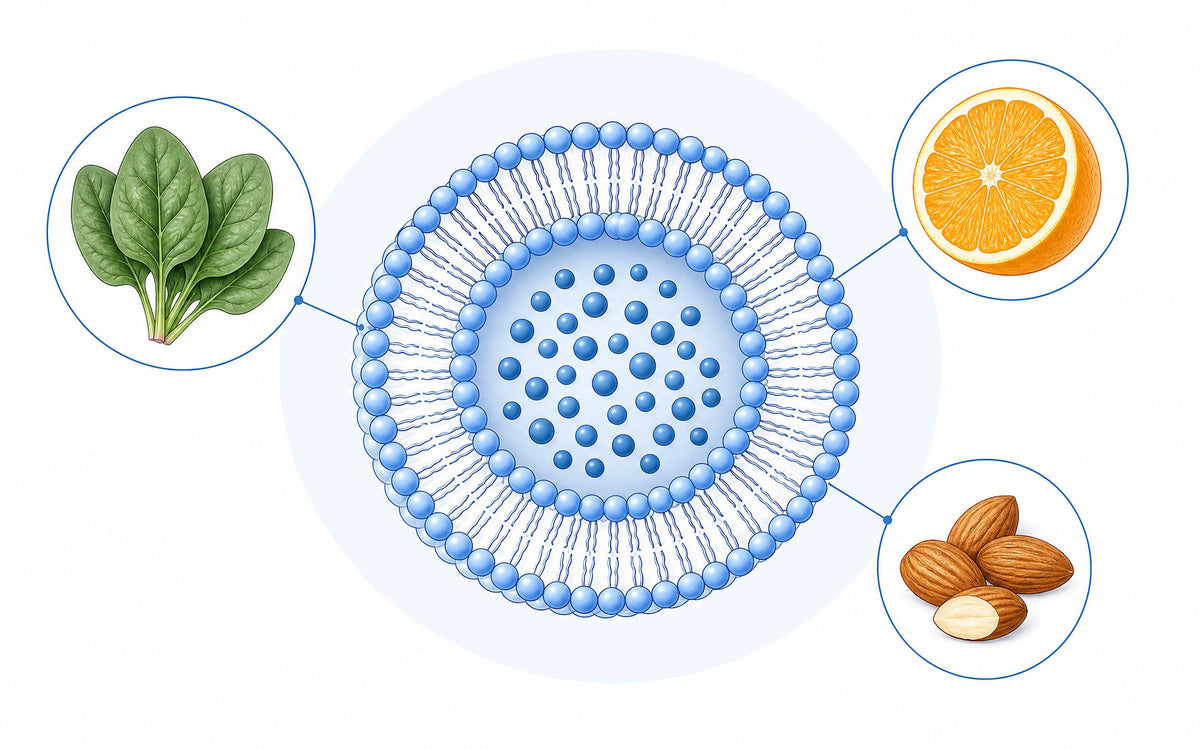
There is no authorised health claim for ashwagandha, nor for the liposomal form. ‘Liposomal’ describes the form the product comes in: the extract is enclosed in liposomes, tiny vesicles made of phospholipids. Our article Liposomal or capsules? explains why the two aren’t opposites. For our liposomal products, we use phospholipids from European sunflowers.
What does KSM-66 on a pack mean?
It means that a particular root extract has been used, standardised to 5% withanolides4. How much of it is in the recommended daily amount is stated on the pack.
Sources
- Mandlik Ingawale DS, Namdeo AG (2021). Pharmacological evaluation of Ashwagandha highlighting its healthcare claims, safety, and toxicity aspects. Journal of Dietary Supplements 18(2):183-226. DOI
- Verma N, Gupta SK, Tiwari S, Mishra AK (2021). Safety of Ashwagandha Root Extract: A Randomized, Placebo-Controlled, study in Healthy Volunteers. Complementary Therapies in Medicine 57:102642. DOI
- Lopresti AL, Smith SJ, Malvi H, Kodgule R (2019). An investigation into the stress-relieving and pharmacological actions of an ashwagandha (Withania somnifera) extract: A randomized, double-blind, placebo-controlled study. Medicine 98(37):e17186. DOI
- Choudhary B, Shetty A, Langade DG (2015). Efficacy of Ashwagandha (Withania somnifera [L.] Dunal) in improving cardiorespiratory endurance in healthy athletic adults. AYU 36(1):63-68. DOI
This article is for general information only and should not replace medical advice. Food supplements are not a substitute for a balanced and varied diet and a healthy lifestyle.
Written by
Melinava Editorial Team