


Your cart is empty

In this article
- Key points
- Is there a right time of day to take glutathione?
- What the studies tell us about taking it
- On an empty stomach or with food?
- Should you take glutathione in the evening?
- Does the liposomal form change the timing?
- When to take glutathione: the short answer
- Frequently asked questions about taking glutathione
- Sources
Key points at a glance
- No time of day has been shown to be better than another for glutathione. We don’t know of any study that has compared morning with evening, or an empty stomach with taking it with a meal.
- Studies measured higher glutathione levels in the blood with daily intake over weeks to months, not after a single dose.
- So choose a fixed time you can easily keep to, and follow the recommended daily amount on the label.
- If you take any medicines, check with your doctor before you start.
Glutathione is a small molecule made up of three amino acids, and your body produces it naturally1. You’ll find more about the substance in our simple guide to glutathione. Here, we look at the practical question of when to take it.
Is there a right time of day to take glutathione?
On current evidence, no. The studies on oral glutathione looked at whether blood levels rise, not at what time of day this works better. We don’t know of any comparison of morning versus evening, or of an empty stomach versus taking it with food. Advice to take it at a particular time of day is therefore based more on habit than on measurements.
What the studies tell us about taking it
The studies do point in one direction, though: higher levels were measured with daily intake, not after a single dose. In an early study with seven healthy volunteers, glutathione in the blood plasma did not rise significantly in the four and a half hours after a single 3 g dose2.
Daily intake was a different story. In a randomised study with 54 adults, participants took 250 or 1,000 mg of glutathione or a placebo every day for six months3.
In those taking glutathione, blood levels were higher after one, three and six months than at the start3. On the higher dose, levels in red blood cells, plasma and lymphocytes had risen by 30 to 35% after six months3.
After a one-month break, levels in this study were back at baseline3. In practice, a regular habit matters more than the perfect time of day.
A small pilot study with liposomal glutathione (12 adults, 500 or 1,000 mg daily) measured higher levels after just one week, and after two weeks an increase of up to 40% in whole blood4. By contrast, a study with conventional, non-liposomal glutathione found no change in red blood cell levels in 40 adults after four weeks of 500 mg twice daily1. These studies did not compare the products directly with each other.
Good to know: The studies are small and lasted six months at most. The pilot study with liposomal glutathione was funded by a manufacturer4. The studies measured blood levels. Whether that also changes how people feel is something these studies don’t tell us.
To see how glutathione absorption is researched, read our article on what studies on oral glutathione examine.
On an empty stomach or with food?
You’ll often read that glutathione should be taken on an empty stomach. We don’t know of any comparative studies on this. Stick to the recommended daily amount on the label, and if taking it on an empty stomach doesn’t agree with you, take it with a light meal.
Which supplements are best taken on an empty stomach and which with food is covered in our article on taking supplements on an empty stomach or with food.
Should you take glutathione in the evening?
There’s no evidence for or against the evening either. Some people take glutathione in the evening because they have more time then, while others prefer the morning as a way to start the day. Both are fine, as long as you take it every day at the same time. Keeping the pack in a set place, next to your toothbrush for example, helps you stick with it.
How best to space different supplements through the day is covered in our article on taking supplements in the morning or evening.
Does the liposomal form change the timing?
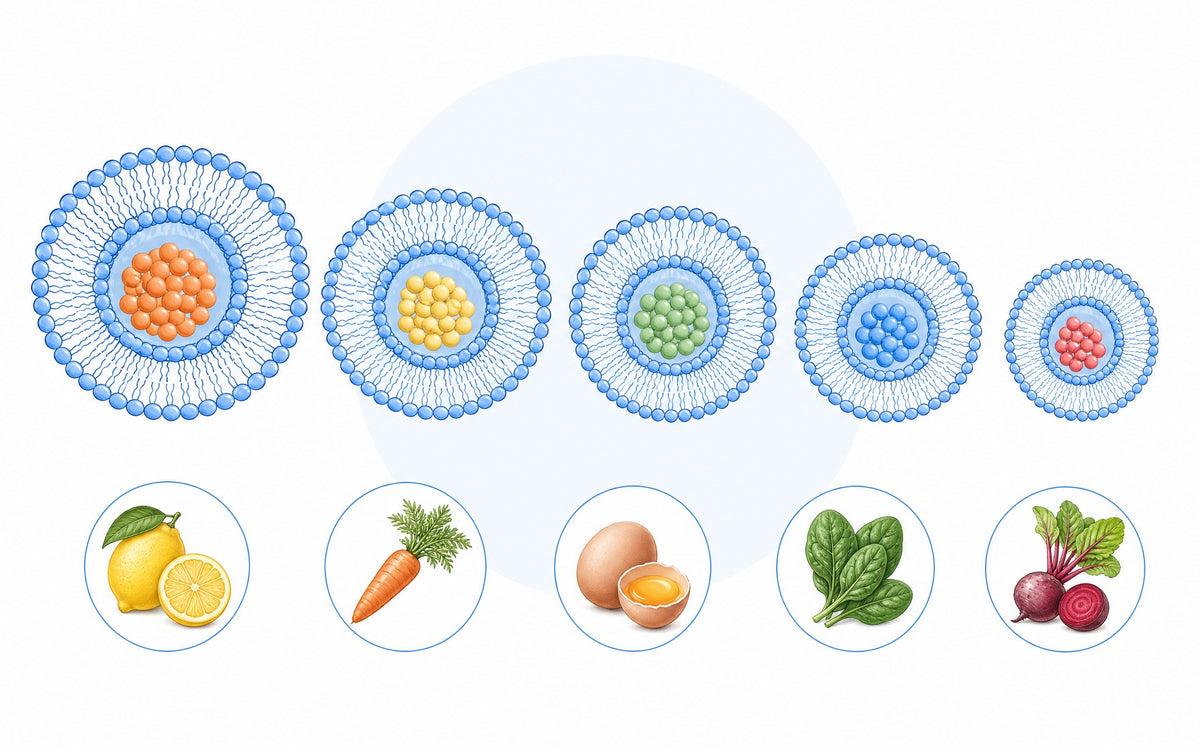
No. For liposomal glutathione, too, no time of day has been shown to be better. The form mainly affects how the contents travel through the stomach and gut: a liposome is a tiny vesicle made of phospholipids that encloses its contents along the way. What’s known about the differences between forms of glutathione is covered in our article on liposomal, reduced and S-acetyl glutathione.
When to take glutathione: the short answer
As far as we know today, what counts with glutathione is regularity, not the time of day. Choose a fixed time that fits into your day. Do not exceed the recommended daily amount.
Frequently asked questions about taking glutathione
Is there an ideal time to take glutathione?
No ideal time has been proven. Studies measured higher blood levels with daily intake over weeks and months3,4. So choose a time you can easily stick to.
When should I take liposomal glutathione?
At a fixed time and as directed on the label. No particular time of day has been proven for the liposomal form either.
Can I take glutathione in the evening?
Yes. There’s no evidence that the evening is better or worse than the morning. What matters is taking it regularly.
Sources
- Allen J, Bradley RD (2011). Effects of oral glutathione supplementation on systemic oxidative stress biomarkers in human volunteers. Journal of Alternative and Complementary Medicine 17(9):827-833. DOI
- Witschi A, Reddy S, Stofer B, Lauterburg BH (1992). The systemic availability of oral glutathione. European Journal of Clinical Pharmacology 43(6):667-669. DOI
- Richie JP Jr, Nichenametla S, Neidig W, et al. (2015). Randomized controlled trial of oral glutathione supplementation on body stores of glutathione. European Journal of Nutrition 54(2):251-263. DOI
- Sinha R, Sinha I, Calcagnotto A, et al. (2018). Oral supplementation with liposomal glutathione elevates body stores of glutathione and markers of immune function. European Journal of Clinical Nutrition 72(1):105-111. DOI
This article is for general information only and should not replace medical advice. Food supplements are not a substitute for a balanced and varied diet and a healthy lifestyle.
Written by
Melinava Editorial Team