

Your cart is empty

In this article
Key points at a glance
- Liposomal or reduced glutathione? You don’t have to choose. ‘Reduced’ describes the form of the molecule, ‘liposomal’ the way it’s packaged and delivered, so a liposomal product can contain reduced glutathione.
- In one older study, a single large dose of glutathione didn’t noticeably raise blood levels1. Taken daily for six months, it did raise them2.
- In a small study with liposomal glutathione, whole-blood levels after two weeks were up to 40% above baseline3.
- S-acetyl glutathione is a chemically modified glutathione that the body appears to convert quickly4.
What is reduced glutathione?
Glutathione is a small molecule made of three amino acids: glutamic acid, cysteine and glycine. Your body makes it itself, inside its cells5. There it exists in two forms, reduced and oxidised. There’s more about the substance itself in our simple guide to glutathione.
Reduced glutathione, or GSH for short, is the form that does the work in the cell’s metabolism. It reacts with reactive oxygen species and, in doing so, turns into the oxidised form itself5. That’s why studies often also measure how much glutathione is present in each of the two forms2. When a product label says ‘reduced glutathione’, it means the form the body itself uses.
Does glutathione actually reach the blood when you swallow it?
The answer depends on how long you look. In a 1992 study, seven healthy adults took about 3 g of glutathione in a single dose. Over the following four and a half hours, glutathione in their blood plasma didn’t rise noticeably. The researchers put this down to enzymes in the gut and liver breaking glutathione down1.
A 2015 study, by contrast, looked at daily intake for six months. 54 adults took 250 or 1,000 mg of glutathione a day, or a placebo. With the higher amount, levels in red blood cells, blood plasma and lymphocytes were 30 to 35% higher after six months than at the start2. One month after stopping, they were back to baseline2.
There’s more on these studies in our article on glutathione absorption studies.
What is liposomal glutathione?
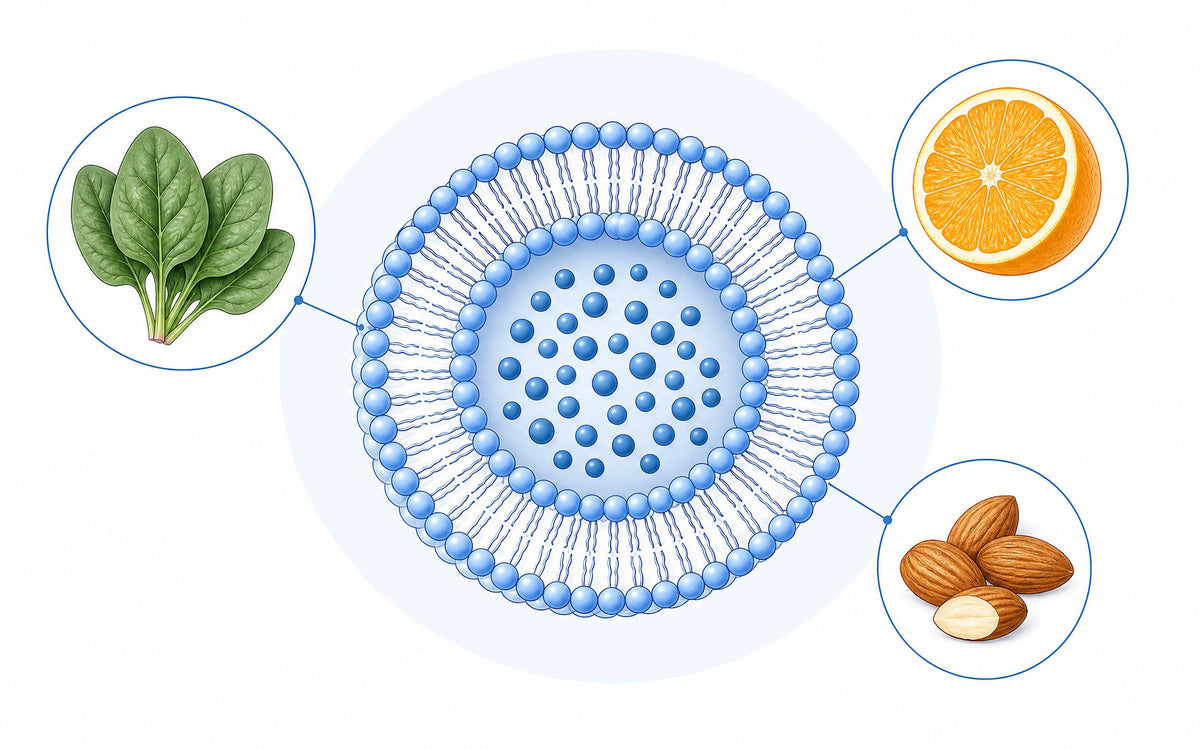
In liposomal glutathione, the glutathione is enclosed in liposomes, tiny vesicles made of phospholipids. Shells like these can protect their contents on the way through the digestive tract6. For a substance that enzymes in the gut and liver break down, that’s a sensible approach1.
In a pilot study, 12 healthy adults took 500 or 1,000 mg of liposomal glutathione a day for one month. Levels had already risen after one week. After two weeks, they were up to 40% above baseline in whole blood, up to 25% in red blood cells and up to 28% in blood plasma3. The ratio of the oxidised to the reduced form fell by 20%3.
The study was small3. It also can’t be compared directly with the six-month study, because the duration, amounts and participants were different.
What is S-acetyl glutathione?
S-acetyl glutathione is glutathione with an acetyl group attached to its sulphur atom. The ‘S’ in the name is the chemical symbol for sulphur. The modified molecule is said to be more stable in the blood and to turn into glutathione only once it’s inside the cells4.
In one study, 18 healthy adults were given S-acetyl glutathione once and conventional glutathione once. After S-acetyl glutathione, both the peak level and the total amount of glutathione in plasma over time (the area under the curve) were higher. S-acetyl glutathione itself couldn’t be detected in the blood, so it’s apparently converted quickly. However, only a single dose was studied4.
Which form is right for you?
Liposomal and reduced aren’t mutually exclusive: a liposomal product can contain reduced glutathione, in which case it’s both. The studies described here looked at the forms in different ways, and none of them compared all three with each other.
- Regularity: in the six-month study, levels fell back to baseline within a month of stopping2. So for blood levels that stay higher, what counts is taking it regularly.
- Format: liposomal glutathione comes as a liquid and in capsules, while glutathione without liposomes also comes as capsules or powder.
- Timing: for the right time of day, see our article on when to take glutathione.
If you’re pregnant, breastfeeding or taking any medicines, check with your doctor first. Do not exceed the recommended daily amount.
For our liposomal products at Melinava, we use phospholipids from European sunflowers.
Glutathione forms: frequently asked questions
What is reduced glutathione?
Reduced glutathione (GSH) is the form your body makes and uses in its cells. When it reacts with reactive oxygen species, it turns into the oxidised form5.
When should you take S-acetyl glutathione?
There’s no set rule. The study on S-acetyl glutathione looked at a single dose, not at different times of day4. Follow the directions on the pack and take it regularly.
Sources
- Witschi A, Reddy S, Stofer B, Lauterburg BH (1992). The systemic availability of oral glutathione. European Journal of Clinical Pharmacology 43(6):667-669. DOI
- Richie JP Jr, Nichenametla S, Neidig W, et al. (2015). Randomized controlled trial of oral glutathione supplementation on body stores of glutathione. European Journal of Nutrition 54(2):251-263. DOI
- Sinha R, Sinha I, Calcagnotto A, et al. (2018). Oral supplementation with liposomal glutathione elevates body stores of glutathione and markers of immune function. European Journal of Clinical Nutrition 72(1):105-111. DOI
- Fanelli S, Francioso A, Cavallaro RA, et al. (2018). Oral Administration of S-acetyl-glutathione: Impact on the Levels of Glutathione in Plasma and in Erythrocytes of Healthy Volunteers. International Journal of Clinical Nutrition & Dietetics 4(2):134. DOI
- Forman HJ, Zhang H, Rinna A (2009). Glutathione: overview of its protective roles, measurement, and biosynthesis. Molecular Aspects of Medicine 30(1-2):1-12. DOI
- Daeihamed M, Dadashzadeh S, Haeri A, Akhlaghi MF (2017). Potential of Liposomes for Enhancement of Oral Drug Absorption. Current Drug Delivery 14(2):289-303. DOI
This article is for general information only and should not replace medical advice. Food supplements are not a substitute for a balanced and varied diet and a healthy lifestyle.
Written by
Melinava Editorial Team