
Your cart is empty

In this article
- Key points
- Which supplements are better taken with food?
- Iron: the classic exception
- Should you take NAC and glutathione on an empty stomach?
- Why take vitamin B12 on an empty stomach?
- Does this also apply to liposomal supplements?
- Rules of thumb for everyday life
- Frequently asked questions about taking supplements on an empty stomach or with food
- Sources
The key points
- Taking a supplement on an empty stomach is worthwhile mainly for iron. Most other supplements can be taken with a meal.
- In studies, vitamin D3, coenzyme Q10 and quercetin were absorbed better when taken with a meal, and vitamin D3 especially with a little fat.
- For NAC, glutathione and vitamin B12, there’s hardly any data on whether an empty stomach or a meal is better.
- Where the evidence is unclear, let tolerance, your daily routine and the directions on the label decide.
‘Take on an empty stomach’ is one of those instructions that’s easy to puzzle over, so let’s start with a clear definition. It means taking something when your stomach is empty, after some time has passed since your last meal. The idea behind it is simple: what you eat can slow down the absorption of a nutrient, or help it along. One important factor is whether a substance is water-soluble or fat-soluble.
Which supplements are better taken with food?
Fat-soluble substances need a little fat to be absorbed well in the gut, which is why they’re usually best taken with a meal. For some of them, there’s evidence from studies in humans.
Vitamin D3 and K2
In one study, 50 healthy older adults each took a single high dose of vitamin D3 with breakfast: some with a meal containing fat, the others with a fat-free meal. With the meal containing fat, the peak vitamin D3 level in the blood was 32% higher than with the fat-free meal1. Whether the fat was monounsaturated or polyunsaturated made no difference1.
Vitamin K2 is fat-soluble too. We didn’t find any studies looking specifically at K2 taken with or without food. Even so, it makes sense to take the two together with a meal. You’ll find more on this in our article on when to take vitamin D3 and K2.
Coenzyme Q10
Coenzyme Q10 is fat-soluble and a large molecule, so it’s absorbed from food slowly and only to a limited extent; in studies, dissolved (solubilised) formulations performed better2. Current evidence suggests that taking it with a meal improves absorption3. In a small study with 13 participants, even the type of food made a difference: with miso soup, the amount in the blood over the first five hours was about 1.5 times as high as with other foods3.
Quercetin
An analysis of 31 human studies concluded that the fat and fibre in food roughly doubled the absorption of quercetin4. So quercetin is another one that goes well with a meal.
Iron: the classic exception
With iron, it’s the other way round. In one study, a breakfast with coffee reduced absorption by 66%, and a cup of coffee on its own by 54%5. The researchers therefore recommend taking iron in the morning, away from meals and coffee, together with a food or drink that contains vitamin C5.
If iron doesn’t agree with you on an empty stomach, you can take it with a small meal, but not with dairy products, coffee or tea. Our article When to take iron? has all the details.
Should you take NAC and glutathione on an empty stomach?
With NAC (N-acetylcysteine), the peak level in the blood is reached one to two hours after taking it6. A pharmacological review from 1991 found no data on how food affects its absorption6. Nor did we find any more recent studies directly comparing taking it on an empty stomach with taking it with food.
The review lists nausea as a common side effect, but that refers to NAC used as a medicine6. If NAC doesn’t agree with you on an empty stomach, you can take it with a meal. The same goes for glutathione: we found no studies comparing an empty stomach with food. There’s more in our article on when to take glutathione.
Why take vitamin B12 on an empty stomach?
You’ll often read this advice. However, we didn’t find a study directly comparing vitamin B12 taken on an empty stomach with vitamin B12 taken with food. So take it at whatever time of day fits well into your routine, and follow the directions on the label.
Does this also apply to liposomal supplements?
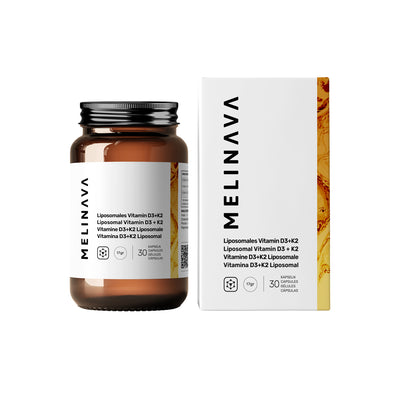
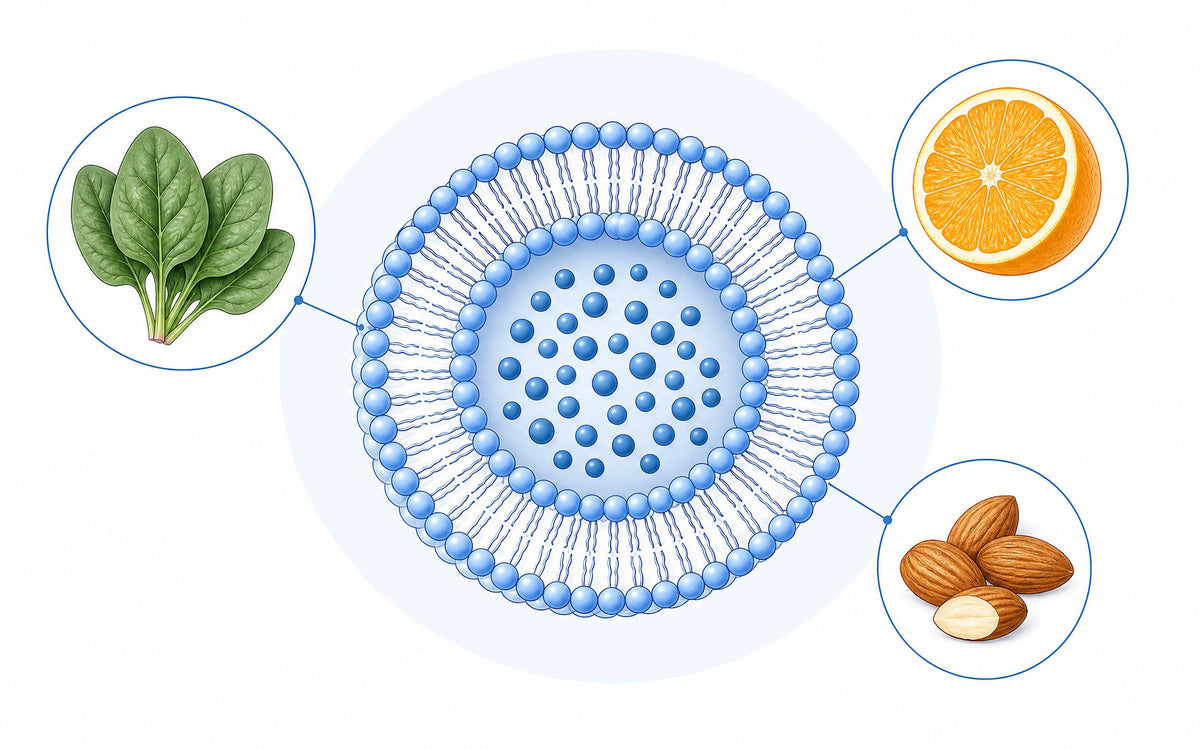
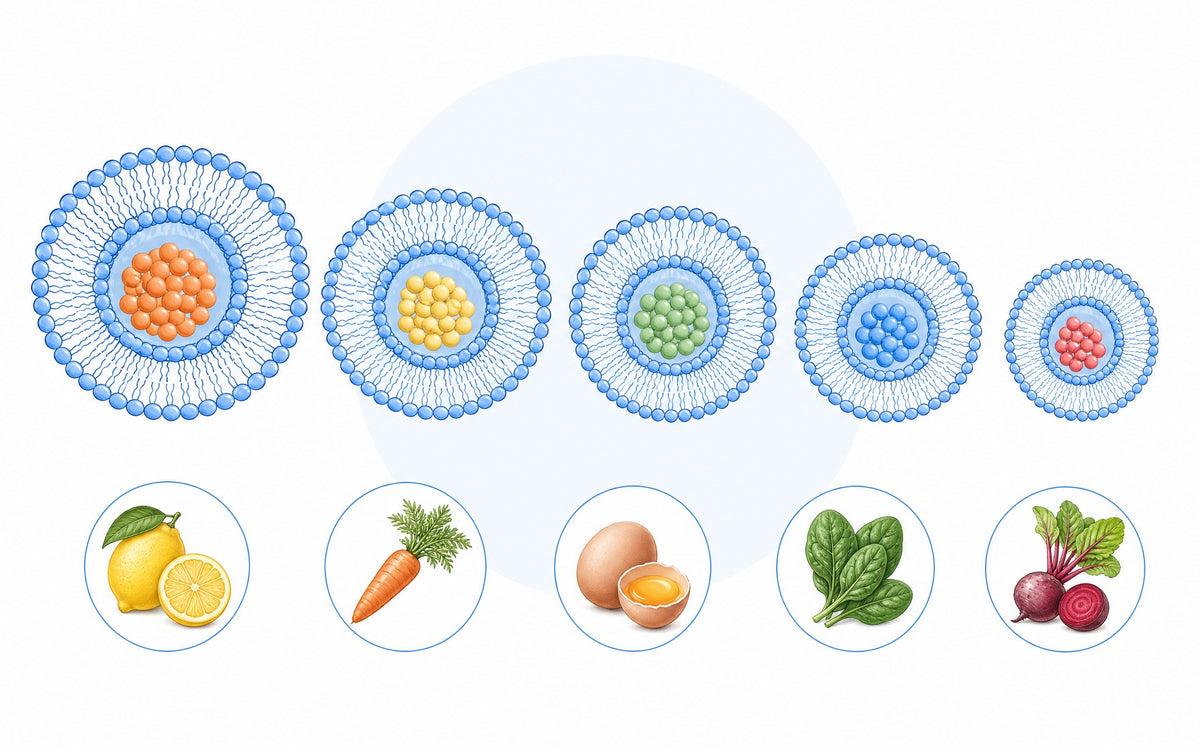
Liposomes are tiny vesicles made from phospholipids, which are fat-like building blocks. We found no studies comparing liposomal supplements taken on an empty stomach with those taken with food. So follow the directions on the label. That applies to our liposomal products too, such as Liposomal Vitamin D3+K2 (Capsules). Our article What are liposomes? explains how liposomes are structured.
Rules of thumb for everyday life
- Iron: in the morning, away from breakfast and coffee, ideally with vitamin C.
- Vitamin D3 and K2, coenzyme Q10, quercetin: with a meal, ideally one with a little fat.
- NAC and glutathione: on an empty stomach or with food, depending on how well you tolerate them.
- Vitamin B12: at a set time of day that suits you.
Good to know: If you take any medicines, check with your doctor first, including how long to leave between your medicines and your food supplement. Do not exceed the recommended daily amount.
Frequently asked questions about taking supplements on an empty stomach or with food
Vitamin D3 and K2 on an empty stomach?
Based on the evidence, it’s better not to. In one study, the peak vitamin D3 level in the blood was 32% higher with a meal containing fat than with a fat-free meal1. So take D3 and K2 with a meal, unless the label says otherwise.
Coenzyme Q10 on an empty stomach?
Better not. Coenzyme Q10 is fat-soluble and only absorbed to a limited extent from food, and current evidence suggests that a meal improves absorption2,3.
NAC on an empty stomach?
You can, but there’s no evidence that it’s any better than taking it with food. If NAC doesn’t agree with you on an empty stomach, take it with a meal.
Related product
Liposomal Vitamin D3+K2 (Capsules)
Manufactured to European pharmaceutical quality.
£38.00
View product
Sources
- Dawson-Hughes B, Harris SS, Lichtenstein AH, Dolnikowski G, Palermo NJ, Rasmussen H (2015). Dietary fat increases vitamin D-3 absorption. Journal of the Academy of Nutrition and Dietetics 115(2):225-230. DOI
- Bhagavan HN, Chopra RK (2006). Coenzyme Q10: absorption, tissue uptake, metabolism and pharmacokinetics. Free Radical Research 40(5):445-453. DOI
- Takahashi M, Nagata M, Kaneko T, Suzuki T (2020). Miso Soup Consumption Enhances the Bioavailability of the Reduced Form of Supplemental Coenzyme Q10. Journal of Nutrition and Metabolism 2020:5349086. DOI
- Liu L, Barber E, Kellow NJ, Williamson G (2025). Improving quercetin bioavailability: A systematic review and meta-analysis of human intervention studies. Food Chemistry 477:143630. DOI
- von Siebenthal HK, Moretti D, Zimmermann MB, Stoffel NU (2023). Effect of dietary factors and time of day on iron absorption from oral iron supplements in iron deficient women. American Journal of Hematology 98(9):1356-1363. DOI
- Holdiness MR (1991). Clinical pharmacokinetics of N-acetylcysteine. Clinical Pharmacokinetics 20(2):123-134. DOI
This article is for general information only and should not replace medical advice. Food supplements are not a substitute for a balanced and varied diet and a healthy lifestyle.
Written by
Melinava Editorial Team