

Your cart is empty

In this article
In brief
- Liposomal astaxanthin is astaxanthin enclosed in tiny vesicles made of phospholipids. The idea behind it: astaxanthin is highly fat-soluble, and the body absorbs it better alongside fat.
- Astaxanthin is a red pigment from the carotenoid group. An important source for food supplements is a microalga.
- There’s no authorised health claim for astaxanthin in the UK or the EU. Among other things, human studies have looked at the skin and measured how much astaxanthin reaches the blood.
- EFSA considers up to 8 mg a day from food supplements safe for adults.
What is astaxanthin?
Astaxanthin is a red pigment that belongs to the carotenoids, or more precisely the xanthophylls1. It’s made by plants and algae and is found in fish and other seafood2. Besides algae and yeasts, natural sources include salmon, trout, krill, prawns and crayfish1. The molecule gets its red colour from a row of double bonds at its centre1.
An important source for food supplements is the microalga Haematococcus pluvialis3. It can store up to 3.8% of its dry weight as astaxanthin1. On a typical diet, you get astaxanthin mainly from fish and crustaceans3.
What does ‘liposomal’ mean for astaxanthin?
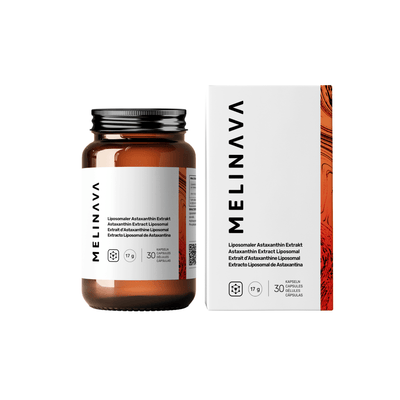
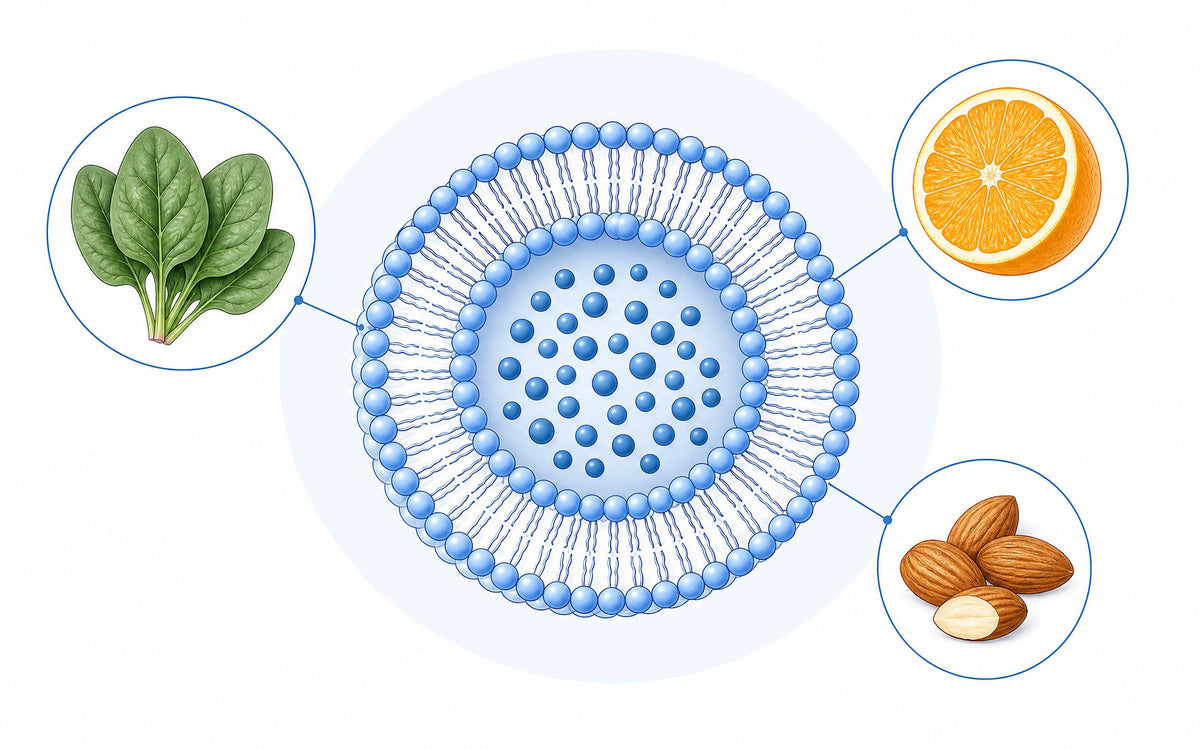
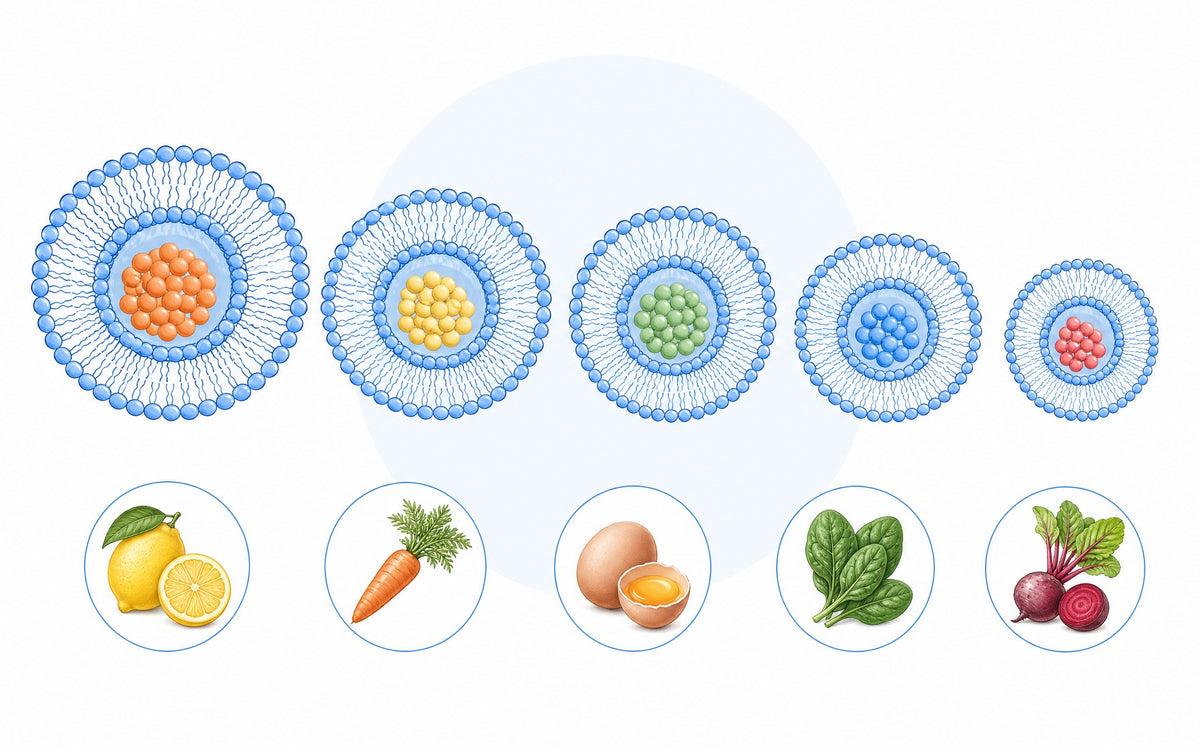
Astaxanthin is highly fat-soluble. As with other carotenoids, this means the body absorbs it only to a limited extent, but better when fat is present2. In liposomal astaxanthin, the substance is embedded in tiny vesicles made of phospholipids, which are fat-like building blocks. For how these vesicles are built, see our article ‘What are liposomes?’
A study in healthy men shows how much difference a fat-based carrier can make. They were given a single 40 mg dose of astaxanthin, either in one of three fat-based formulations or as a commercially available food supplement2. From the fat-based formulations, the body absorbed 1.7 to 3.7 times as much2. Liposomes weren’t among the formulations tested, but they’re also a fat-based carrier.
According to a review, liposomes are used mainly for fat-soluble substances such as astaxanthin4. The review counts them among the carrier systems that could increase astaxanthin absorption, although the data for this come from cell and laboratory experiments4.
1.7 to 3.7
times as much astaxanthin was absorbed by the body from fat-based formulations2.
8 mg
a day from food supplements is considered safe for adults by EFSA3.
Astaxanthin benefits: what have human studies measured?
There’s no authorised health claim for astaxanthin in the UK or the EU. That’s why this article only describes what studies have measured. An analysis of nine randomised studies of astaxanthin taken orally found that skin moisture and elasticity were higher than with a placebo, while for wrinkle depth the difference was not clear5.
In some cases, the results of the individual studies varied considerably5. Our article ‘Understanding the evidence’ explains how to read analyses like this.
How much astaxanthin is considered safe?
In 2020 the European Food Safety Authority (EFSA) assessed whether up to 8 mg of astaxanthin a day from food supplements is safe, and concluded that it is safe for adults3. For teenagers and children, however, this amount would reach or exceed the acceptable daily intake (ADI)3. According to the 2019 assessment, the ADI is 0.2 mg per kilogram of body weight3.
Good to know: In its assessment, EFSA also took into account the astaxanthin you get from fish and crustaceans. So the 8 mg is on top of what you get from a typical diet3.
When should you take astaxanthin?
Because the body absorbs astaxanthin better when fat is present2, a meal containing some fat is a good time to take it. Astaxanthin stays in the blood for quite a long time: in the study in healthy men, its half-life (the time it takes for the blood level to fall by half) was around 16 hours2.
Don’t take more than the recommended daily amount, and if you take any medicines, check with your doctor first. For our liposomal products, we use phospholipids from European sunflowers. That includes our Liposomal Astaxanthin Extract.
Frequently asked questions about astaxanthin
What is liposomal astaxanthin?
It’s astaxanthin embedded in tiny vesicles made of phospholipids. Liposomes are used mainly for fat-soluble substances like astaxanthin4.
What is astaxanthin good for, and what do we know about its effects?
No health claims about its effects are authorised for astaxanthin in the UK or the EU. Among other things, human studies have taken skin measurements: in an analysis of nine studies, skin moisture and elasticity were higher with astaxanthin than with a placebo5.
Astaxanthin: liposomal or not?
What’s certain is that fat increases absorption: in one study, fat-based formulations delivered 1.7 to 3.7 times as much to the blood as a commercially available product2. Liposomes are also a fat-based carrier. In our research, we didn’t find any human studies that directly compare liposomal astaxanthin with other forms.
Related product
Liposomal Astaxanthin Extract
Manufactured to European pharmaceutical quality.
£35.00
View product
Sources
- Ambati RR, Phang SM, Ravi S, Aswathanarayana RG (2014). Astaxanthin: sources, extraction, stability, biological activities and its commercial applications. A review. Marine Drugs 12(1):128-152. DOI
- Mercke Odeberg J, Lignell A, Pettersson A, Höglund P (2003). Oral bioavailability of the antioxidant astaxanthin in humans is enhanced by incorporation of lipid based formulations. European Journal of Pharmaceutical Sciences 19(4):299-304. DOI
- EFSA Panel on Nutrition, Novel Foods and Food Allergens (NDA), Turck D, Castenmiller J, et al. (2020). Safety of astaxanthin for its use as a novel food in food supplements. EFSA Journal 18(2):e05993. DOI
- Abdol Wahab NR, Meor Mohd Affandi MMR, Fakurazi S, Alias E, Hassan H (2022). Nanocarrier System: State-of-the-Art in Oral Delivery of Astaxanthin. Antioxidants 11(9):1676. DOI
- Zhou X, Cao Q, Orfila C, Zhao J, Zhang L (2021). Systematic Review and Meta-Analysis on the Effects of Astaxanthin on Human Skin Ageing. Nutrients 13(9):2917. DOI
This article is for general information only and should not replace medical advice. Food supplements are not a substitute for a balanced and varied diet and a healthy lifestyle.
Written by
Melinava Editorial Team