

Your cart is empty

In this article
At a glance
- Why take vitamin D3 with K2? Both vitamins are involved in calcium metabolism, and both carry the same authorised claim: vitamin D contributes to the maintenance of normal bones, and vitamin K contributes to the maintenance of normal bones.
- Researchers describe an interplay between the two: vitamin D promotes the formation of proteins that need vitamin K to become active.
- If you’re outdoors regularly, your skin makes most of your vitamin D. At latitudes like Germany’s, the sun isn’t strong enough for this from October to March. Vitamin K2 is found in animal products and fermented foods.
- Vitamin D also contributes to the normal function of the immune system, and vitamin K contributes to normal blood clotting.
What is vitamin D3?
Vitamin D stands out among the vitamins because your body can make it itself when sunlight falls on your skin. If you’re regularly outdoors, 80 to 90% of your vitamin D comes from your own skin and only 10 to 20% from food1. Only a few foods contain significant amounts, mainly oily fish such as salmon, herring and mackerel1.
At latitudes like Germany’s, the sun is too weak from October to March for the skin to make enough vitamin D. The body then draws on its stores in fat and muscle tissue1. According to the German Nutrition Society (Deutsche Gesellschaft für Ernährung, DGE), almost 60% of people in Germany don’t reach the desirable level of vitamin D in the blood1.
Vitamin D in supplements comes in two forms, D2 and D3. A meta-analysis of randomised trials concluded that vitamin D3 raises the level of vitamin D in the blood more effectively than vitamin D22. The authors therefore see D3 as the form that could be preferred in supplements in future2.
What is vitamin K2?
Vitamin K is a collective name for several compounds. Vitamin K1 (phylloquinone) comes from plants, and the main good sources are green vegetables. The vitamin K2 compounds (menaquinones) are found in animal products and fermented foods3. How well your body absorbs vitamin K depends, among other things, on the fat in the meal3.
In the body, vitamin K is needed to activate certain proteins, known as Gla proteins. These include the clotting factors in the liver and proteins outside the liver, such as osteocalcin in bone4. Even in healthy people, 10 to 40% of these proteins outside the liver aren’t activated4.
A study in 42 healthy adults looked at how extra vitamin K2 affects the blood. The participants took menaquinone-7, a form of vitamin K2, in different amounts, or a placebo. Amounts in the region of the daily reference intake raised the proportion of activated osteocalcin in the blood4. Thrombin generation, a measure of blood clotting, didn’t change as a result4.
Why are vitamin D3 and K2 combined?
Both vitamins are fat-soluble and play a central role in calcium metabolism. Researchers describe how they work together like this: vitamin D promotes the formation of proteins that need vitamin K to become active5.
The authorised health claims overlap, too. Vitamin D contributes to the maintenance of normal bones, and vitamin K contributes to the maintenance of normal bones. Vitamin D also contributes to normal absorption/utilisation of calcium and phosphorus and to normal blood calcium levels. That’s the basic idea behind the combination: two vitamins involved in the same metabolism, in one product.
Most studies on the combination looked at women after the menopause and measured bone parameters5. There’s no separate authorised health claim for the pair: the claims apply to each vitamin on its own. What the studies examined in detail is covered in our article on what studies on vitamin D3 and K2 investigate.
Can you take vitamin D3 without K2?
Yes. The authorised health claims for vitamin D apply to the vitamin itself. Besides bones, vitamin D contributes to the maintenance of normal muscle function, the maintenance of normal teeth and the normal function of the immune system. It also has a role in the process of cell division. K2 adds a second vitamin that also contributes to the maintenance of normal bones, and contributes to normal blood clotting as well.
Your vitamin D status is shown by the blood level of 25-hydroxyvitamin D1. If you’re unsure, ask your GP to have it measured. If you take any medication, get medical advice first. For vitamin K, this applies especially to medicines that affect blood clotting.
Vitamin D3 and K2: a summary
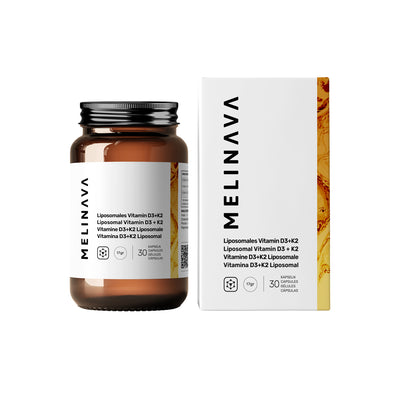
Vitamin D3 and K2 are combined because both are involved in calcium metabolism. Vitamin D contributes to the maintenance of normal bones, and vitamin K contributes to the maintenance of normal bones. In the sunnier half of the year, your body makes a large part of its vitamin D itself; vitamin K2 comes from animal products and fermented foods. You’ll find both vitamins together in our Liposomal Vitamin D3+K2 (Capsules).
Frequently asked questions about vitamin D and K2
Why take vitamin D3 with K2?
Both vitamins are involved in calcium metabolism. Vitamin D contributes to the maintenance of normal bones, and vitamin K contributes to the maintenance of normal bones. Researchers describe how vitamin D promotes the formation of proteins that need vitamin K to become active5. When and how to take the two is explained in our article on when and how to take vitamin D3 and K2. Do not exceed the recommended daily amount.
What are vitamin D3 and K2 good for?
Vitamin D contributes to the maintenance of normal bones, the maintenance of normal teeth, the maintenance of normal muscle function and the normal function of the immune system. Vitamin K contributes to normal blood clotting and the maintenance of normal bones. These are authorised health claims.
What is a vitamin D3 and K2 supplement?
The name refers to products that combine vitamin D3 with vitamin K2, for example in the form of menaquinone-7. They come as drops and as capsules. How the two forms differ is explained in our article Vitamin D3 and K2: drops or capsules?
Related product
Liposomal Vitamin D3+K2 (Capsules)
Manufactured to European pharmaceutical quality.
£38.00
View product
Sources
- Deutsche Gesellschaft für Ernährung (n.d., accessed 22 October 2026). FAQ Vitamin D. Link
- Tripkovic L, Lambert H, Hart K, et al. (2012). Comparison of vitamin D2 and vitamin D3 supplementation in raising serum 25-hydroxyvitamin D status: a systematic review and meta-analysis. The American Journal of Clinical Nutrition 95(6):1357-1364. DOI
- Deutsche Gesellschaft für Ernährung (n.d., accessed 22 October 2026). Vitamin K: Referenzwerte für die Nährstoffzufuhr. Link
- Theuwissen E, Cranenburg EC, Knapen MH, et al. (2012). Low-dose menaquinone-7 supplementation improved extra-hepatic vitamin K status, but had no effect on thrombin generation in healthy subjects. British Journal of Nutrition 108(9):1652-1657. DOI
- van Ballegooijen AJ, Pilz S, Tomaschitz A, Grübler MR, Verheyen N (2017). The Synergistic Interplay between Vitamins D and K for Bone and Cardiovascular Health: A Narrative Review. International Journal of Endocrinology 2017:7454376. DOI
This article is for general information only and should not replace medical advice. Food supplements are not a substitute for a balanced and varied diet and a healthy lifestyle.
Written by
Melinava Editorial Team