

Your cart is empty

In this article
Key points at a glance
- How vitamin D and vitamin K work together is well understood biologically. Reviews suggest the combination may do more than either vitamin alone, but this hasn’t been settled yet1,2.
- Most studies on the combination were carried out in postmenopausal women1.
- In a study of 42 healthy adults, vitamin K2 in amounts around the EU reference value raised the proportion of certain activated proteins in the blood3.
- There are authorised health claims for both vitamins: vitamin D and vitamin K each contribute to the maintenance of normal bones.
Why are vitamin D3 and K2 combined?
Vitamin D and vitamin K are both fat-soluble, and both play a central role in calcium metabolism1. For vitamin D, there’s an authorised health claim: vitamin D contributes to normal absorption/utilisation of calcium and phosphorus.
The reason for combining them lies in the way they work together. Vitamin D prompts the body to make proteins that can’t do their job without vitamin K1. Two of these matter most for bones: osteocalcin and matrix Gla protein. Vitamin K is needed to switch them into their active, so-called carboxylated form4.
We explain the mechanism in detail in our article on why vitamin D3 is taken with K2. Here, we look at what the studies actually measured.
What do vitamin K2 studies measure?
Many studies measure how much of these proteins in the blood has been activated. Normally, 10 to 40% of osteocalcin and matrix Gla protein stays in the inactive form3. Studies use this proportion as a marker of how well tissues outside the liver are supplied with vitamin K3.
In a randomised study, 42 healthy adults aged 18 to 45 were given either a placebo or vitamin K2 as menaquinone-7, split across seven groups with daily amounts ranging from 10 to 360 µg3. For the analysis, the researchers pooled these into three groups: placebo, amounts below the EU reference value for vitamin K and amounts around it3.
With amounts around the reference value, the proportion of activated proteins in the blood went up. Taking vitamin K2 had no adverse effect on blood clotting measurements3. According to the authors, studies designed specifically for that purpose would be needed to find out whether this change benefits health3. For vitamin K, there’s an authorised health claim: vitamin K contributes to normal blood clotting.
What do review articles say about the combination?
A 2024 review identified 31 studies in which postmenopausal women took vitamin D and K together2. Overall, the authors see signs of possible benefits from the combination, including for bones. At the same time, they emphasise the importance of a diet rich in vegetables and fermented dairy products2.
A second review from the same year comes to a similarly cautious conclusion. In the authors’ view, getting enough vitamin K appears to play an additional part in maintaining bones when vitamin D status is good, but more research is needed on how the two vitamins work together4.
An older review also considers it possible that the combination is more effective than either vitamin on its own. However, it points out that most of the studies were carried out in postmenopausal women1.
Good to know: many studies measure intermediate markers in the blood, such as the proportion of activated proteins. Whether this leads to an actual benefit has to be shown by studies designed for that purpose3. And results from one group, such as postmenopausal women, can’t simply be applied to everyone1,2.
What should you bear in mind when taking them?
The studies used very different amounts: in the K2 study, for example, 10 to 360 µg a day3. You can’t work out a single amount that’s right for everyone from this. That’s why you should follow the directions on the pack. Do not exceed the recommended daily amount.
If you take any medicines, speak to your doctor first. This applies especially to vitamin K, because it contributes to normal blood clotting. Our guide to when and how to take vitamin D3 and K2 covers the details.
How should we weigh up the evidence overall?
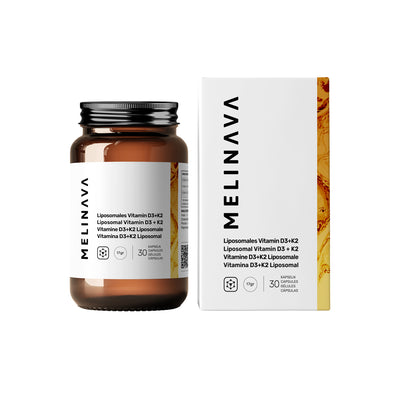
The interplay between vitamin D and K is well understood biologically, and studies measure a higher proportion of activated proteins with vitamin K21,3. Whether the combination brings any additional benefit in everyday life is still being researched. If you’re wondering whether drops or capsules would suit you better, see our article on vitamin D3 and K2 as drops or capsules. At Melinava, we offer Liposomal Vitamin D3+K2 (Capsules), made with phospholipids from European sunflowers.
Frequently asked questions about vitamin D3 and K2 studies
Are there scientific studies on vitamin D3 and K2?
Yes. A review identified 31 studies in which postmenopausal women took the two vitamins together2. There are also studies on vitamin K2 alone, which mainly measure markers in the blood3.
What does the combination achieve, according to the studies?
Studies point to an interplay between the two vitamins, but a clear additional benefit hasn’t been proven yet4. The authorised health claims relate to the individual vitamins: vitamin D contributes to the maintenance of normal bones, and vitamin K contributes to the maintenance of normal bones.
Related product
Liposomal Vitamin D3+K2 (Capsules)
Manufactured to European pharmaceutical quality.
£38.00
View product
Sources
- van Ballegooijen AJ, Pilz S, Tomaschitz A, Grübler MR, Verheyen N (2017). The Synergistic Interplay between Vitamins D and K for Bone and Cardiovascular Health: A Narrative Review. International Journal of Endocrinology 2017:7454376. DOI
- Rusu ME, Bigman G, Ryan AS, Popa DS (2024). Investigating the Effects and Mechanisms of Combined Vitamin D and K Supplementation in Postmenopausal Women: An Up-to-Date Comprehensive Review of Clinical Studies. Nutrients 16(14):2356. DOI
- Theuwissen E, Cranenburg EC, Knapen MH, et al. (2012). Low-dose menaquinone-7 supplementation improved extra-hepatic vitamin K status, but had no effect on thrombin generation in healthy subjects. British Journal of Nutrition 108(9):1652-1657. DOI
- Aaseth JO, Finnes TE, Askim M, Alexander J (2024). The Importance of Vitamin K and the Combination of Vitamins K and D for Calcium Metabolism and Bone Health: A Review. Nutrients 16(15):2420. DOI
This article is for general information only and should not replace medical advice. Food supplements are not a substitute for a balanced and varied diet and a healthy lifestyle.
Written by
Melinava Editorial Team