

Your cart is empty

In this article
Key points at a glance
- No time of day has been shown to be better than another for vitamin C, so take it at whatever time you find easiest to stick with.
- With conventional vitamin C, the body absorbs a smaller share when a single dose is large, so larger amounts are best split up.
- For liposomal vitamin C, nine out of ten comparison studies measured higher blood levels than with conventional vitamin C. Here too, you can take it at any time of day that suits you.
- If you take iron, take vitamin C at the same time. Vitamin C increases iron absorption.
Vitamin C is water-soluble and is found mainly in fruit and vegetables1. If you take it as a supplement, you’ve probably wondered when the right moment is. The answer has less to do with the clock than with how much you take at once, and whether you’re taking iron at the same time.
Morning or evening: is there a right time?
We don’t know of any study that directly compares vitamin C taken in the morning with vitamin C taken in the evening. That means there’s no evidence-based recommendation for the time of day. Choose a moment when the habit is easy to keep up, breakfast for example.
Many people link vitamin C with the morning, perhaps a glass of orange juice at breakfast. That’s a good habit, but it isn’t a rule. If your evenings are calmer, simply take it then.
What happens with large doses
A study with seven healthy volunteers measured precisely how the body absorbs conventional vitamin C. A single dose of 200 mg was fully absorbed2. From 500 mg per dose, the share absorbed fell and more vitamin C was excreted in the urine2.
So if you take larger amounts of conventional vitamin C, it makes sense to split them into two doses, for example one in the morning and one in the evening. The study was small but very precise: the seven participants lived in hospital for four to six months and were given a strictly controlled diet2.
Liposomal vitamin C: when should you take it?
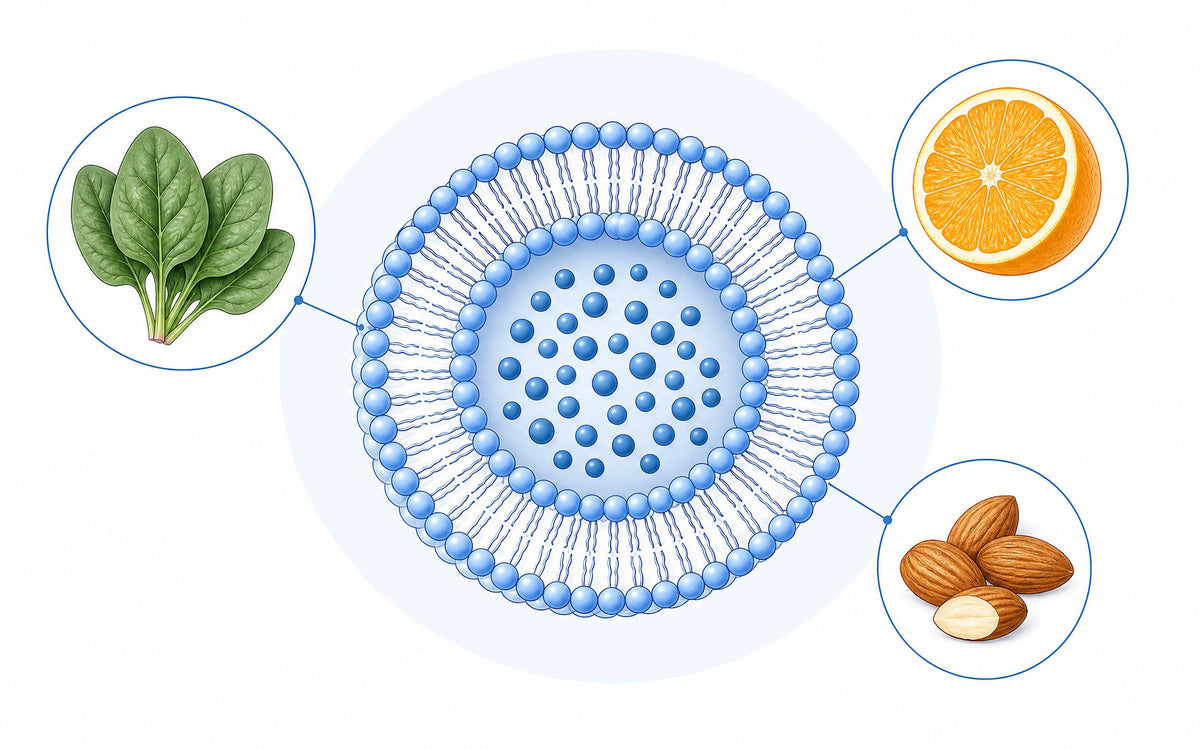
The same basic rules apply to liposomal vitamin C: take it regularly and stick to the recommended daily amount on the label. No particular time of day has been proven here either. Studies on this form have mainly looked at how much reaches the blood.
A review found ten studies comparing liposomal with conventional vitamin C. Nine of them measured higher blood levels with the liposomal form, using very different formulations and amounts3.
In a study with 27 adults, each participant was given 500 mg of conventional vitamin C on one occasion and 500 mg of liposomal vitamin C on another. With the liposomal form, the peak plasma level was 27% higher, and 21% higher when calculated over 24 hours4. You’ll find more on this in our article What the evidence on liposomal vitamin C shows.
9 out of 10
studies measured higher blood levels with liposomal vitamin C than with conventional vitamin C3.
27%
higher peak plasma level with 500 mg of liposomal vitamin C than with the same amount of conventional vitamin C4.
Good to know: The formulations and amounts differed widely between the studies, which makes them hard to compare3. None of them looked at how much vitamin C was then excreted in the urine3.
Vitamin C together with iron
There’s one case where timing really does matter: when you take iron. Vitamin C increases iron absorption5. In a study with 34 women, the share of iron absorbed rose by 30% when they took 80 mg of vitamin C at the same time6. So take your vitamin C together with the iron.
Our article Taking iron with vitamin C covers what else to bear in mind.
On an empty stomach or with food?
Here too, we don’t know of any comparison study that would allow a clear recommendation. If your stomach is sensitive when it’s empty, taking it with a meal is the more comfortable choice. Vitamin C is also called ascorbic acid1. Our article Vitamin C forms: liposomal, buffered or ascorbic acid explains which forms are used in supplements and how they differ.
When to take vitamin C: the short answer
No time of day has been proven better for vitamin C. Split larger amounts of conventional vitamin C into two doses. And if you take iron, take vitamin C at the same time.
Do not exceed the recommended daily amount. If you take any medicines, check with your doctor first.
Frequently asked questions about taking vitamin C
Should you take vitamin C in the morning or the evening?
Neither has been proven better. Choose the time you can stick with. With conventional vitamin C, the amount per dose matters more than the time on the clock2.
When should you take liposomal vitamin C?
Take it regularly and as directed on the label. No particular time of day has been proven. If you take iron, take the vitamin C at the same time.
Sources
- Deutsche Gesellschaft für Ernährung (2015). Referenzwerte für die Nährstoffzufuhr: Vitamin C. Link
- Levine M, Conry-Cantilena C, Wang Y, et al. (1996). Vitamin C pharmacokinetics in healthy volunteers: evidence for a recommended dietary allowance. Proceedings of the National Academy of Sciences 93(8):3704-3709. DOI
- Carr AC (2025). Do Liposomal Vitamin C Formulations Have Improved Bioavailability? A Scoping Review Identifying Future Research Directions. Basic & Clinical Pharmacology & Toxicology 137(1):e70067. DOI
- Purpura M, Jäger R, Godavarthi A, Bhaskarachar D, Tinsley GM (2024). Liposomal delivery enhances absorption of vitamin C into plasma and leukocytes: a double-blind, placebo-controlled, randomized trial. European Journal of Nutrition 63(8):3037-3046. DOI
- European Commission (2012). Commission Regulation (EU) No 432/2012 of 16 May 2012 establishing a list of permitted health claims made on foods, other than those referring to the reduction of disease risk and to children’s development and health. Link
- von Siebenthal HK, Moretti D, Zimmermann MB, Stoffel NU (2023). Effect of dietary factors and time of day on iron absorption from oral iron supplements in iron deficient women. American Journal of Hematology 98(9):1356-1363. DOI
This article is for general information only and should not replace medical advice. Food supplements are not a substitute for a balanced and varied diet and a healthy lifestyle.
Written by
Melinava Editorial Team