

Your cart is empty

In this article
The key points at a glance
- Liposomal or buffered vitamin C? These are two different properties, not opposites. Buffered means the vitamin comes as a mild salt; liposomal means it’s enclosed in tiny vesicles made of fats (lipids).
- In 9 out of 10 comparative studies, a liposomal form delivered more vitamin C to the blood than conventional vitamin C1.
- In studies, a buffered calcium ascorbate was better tolerated than pure ascorbic acid2.
- The authorised health claims for vitamin C apply to each of these forms.
What is ascorbic acid?
Ascorbic acid is vitamin C in its simplest form. It’s the form you’ll find most often in food supplements, and the body uses it just as well as the vitamin C in fruit and vegetables3. Because it’s an acid, it has a distinctly sour taste.
Two of its characteristics are well known. From a large single dose, the body absorbs a smaller proportion than from moderate amounts, and very high amounts can upset the stomach and gut3. This is exactly where the other forms come in.
What is buffered vitamin C?
Buffered vitamin C is a salt of ascorbic acid, known as an ascorbate. The vitamin is bound to a mineral such as calcium, sodium or magnesium. These ascorbates are authorised in the EU for use in food supplements4. They’re less acidic than ascorbic acid and taste milder.
A review published in 2025 looked at how well buffered vitamin C is tolerated. It assessed 13 studies in healthy adults covering various forms of vitamin C. In that analysis, a calcium ascorbate containing vitamin C metabolites was better tolerated than ascorbic acid and caused discomfort in the upper abdomen less often2.
This finding rests on studies of a single calcium ascorbate sold under a brand name: 7 of the 13 studies were on this product2. So it doesn’t yet show that every buffered vitamin C is tolerated equally well.
What is liposomal vitamin C?
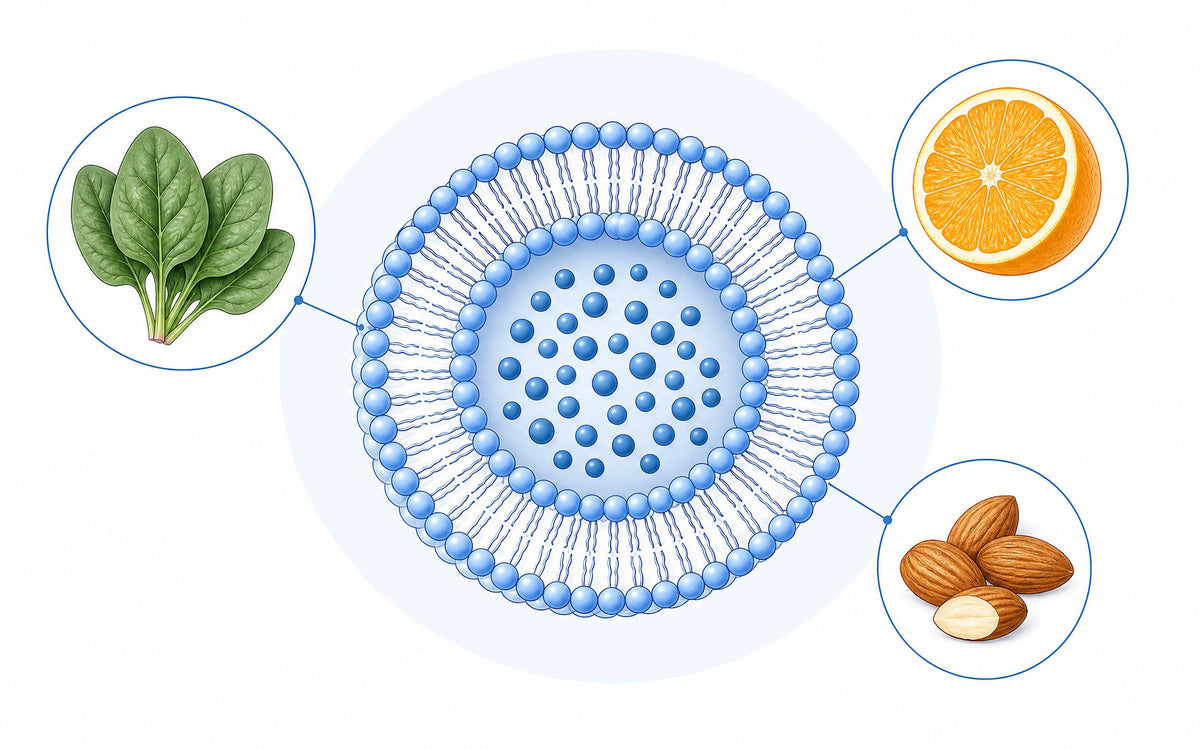
In liposomal vitamin C, the vitamin is enclosed in tiny vesicles made of fats (lipids), called liposomes. The aim is higher bioavailability: more of the vitamin C you take is meant to reach the blood1.
Another review found ten human studies comparing liposomal with conventional vitamin C. In nine of them, more vitamin C reached the blood with the liposomal form, with a peak level 1.2 to 5.4 times higher1. However, the formulations and amounts varied widely, with amounts ranging from 0.15 to 10 g1.
In one of the more recent studies, 27 healthy adults took 500 mg of liposomal vitamin C on one occasion and 500 mg of conventional vitamin C on another. With the liposomal form, the peak level in blood plasma was 27% higher, and 21% higher across the full 24 hours. More vitamin C was also found in the white blood cells5.
Good to know: the studies on liposomal vitamin C mainly measured how much vitamin C reaches the blood in the hours after taking it1. What the individual studies show, and how to interpret measurements like these, is covered in our article Liposomal vitamin C: what the evidence shows.
Liposomal or buffered vitamin C: what’s the difference?
The two terms answer different questions. ‘Buffered’ tells you which chemical form the vitamin C is in; ‘liposomal’ tells you how it’s packaged. They aren’t opposites: liposomes can contain pure ascorbic acid or an ascorbate. What’s inside is stated on the label.
The studies also focus on different things: for buffered vitamin C, mainly tolerability; for liposomal vitamin C, the amount that reaches the blood1,2. So when you’re choosing, it helps to ask which of these matters more to you.
Which form suits you?
- If what matters to you is how much vitamin C reaches the blood: for liposomal forms, almost all comparative studies measured higher blood levels1.
- If you don’t tolerate acidic things well: a buffered ascorbate is milder, and in studies a calcium ascorbate was better tolerated than ascorbic acid2.
- If you want something easy to take: capsules have no taste, even when they contain sour ascorbic acid, and they slip into any bag. Powders and liquids let you adjust the dose precisely. You’ll find more on this in our article on drops, capsules or powder.
The authorised health claims for vitamin C apply to every form, whether it’s ascorbic acid, an ascorbate or liposomal. They read: ‘Vitamin C contributes to the normal function of the immune system’ and ‘Vitamin C contributes to the reduction of tiredness and fatigue’6.
When in the day vitamin C fits in well is covered in our article Vitamin C: when to take it? Do not exceed the recommended daily amount.
For our liposomal products at Melinava, we use phospholipids from European sunflowers.
Frequently asked questions about the forms of vitamin C
What is ‘vitamin C ester’?
The term is used for two different things. The first is a buffered calcium ascorbate containing vitamin C metabolites such as L-threonate, sold under a brand name2. The second is a true ester such as ascorbyl palmitate, a compound of vitamin C and a fatty acid. According to current knowledge, ascorbyl palmitate is almost completely split into vitamin C and the fatty acid before it’s absorbed7.
Liposomal or standard vitamin C: what’s the difference?
In liposomal vitamin C, the vitamin sits inside liposomes. In 9 out of 10 comparative studies, more vitamin C reached the blood than with conventional vitamin C1. The authorised health claims for vitamin C apply to both forms.
Why is vitamin C buffered?
To make it milder. Pure ascorbic acid is an acid, while a buffered ascorbate is less acidic. In studies, a calcium ascorbate was better tolerated than ascorbic acid2. If you don’t tolerate acidic things well, this can be more pleasant.
Sources
- Carr AC (2025). Do Liposomal Vitamin C Formulations Have Improved Bioavailability? A Scoping Review Identifying Future Research Directions. Basic & Clinical Pharmacology & Toxicology 137(1):e70067. DOI
- Calder PC, Kreider RB, McKay DL (2025). Enhanced Vitamin C Delivery: A Systematic Literature Review Assessing the Efficacy and Safety of Alternative Supplement Forms in Healthy Adults. Nutrients 17(2):279. DOI
- NIH Office of Dietary Supplements (2025). Vitamin C: Health Professional Fact Sheet. Link
- European Parliament and Council of the European Union (2002). Directive 2002/46/EC on food supplements, Annex II (consolidated version of 26 November 2025). Link
- Purpura M, Jäger R, Godavarthi A, Bhaskarachar D, Tinsley GM (2024). Liposomal delivery enhances absorption of vitamin C into plasma and leukocytes: a double-blind, placebo-controlled, randomized trial. European Journal of Nutrition 63(8):3037-3046. DOI
- European Commission (2012). Commission Regulation (EU) No 432/2012 of 16 May 2012 establishing a list of permitted health claims made on foods, other than those referring to the reduction of disease risk and to children’s development and health (consolidated version of 20 August 2025). Link
- EFSA Panel on Food Additives and Nutrient Sources added to Food (2015). Scientific Opinion on the re-evaluation of ascorbyl palmitate (E 304(i)) and ascorbyl stearate (E 304(ii)) as food additives. EFSA Journal 13(11):4289. DOI
This article is for general information only and should not replace medical advice. Food supplements are not a substitute for a balanced and varied diet and a healthy lifestyle.
Written by
Melinava Editorial Team