

Your cart is empty

In this article
At a glance
- In nine out of ten comparison studies, blood levels were higher with liposomal vitamin C than with conventional vitamin C1.
- The studies mainly measured how much vitamin C reached the blood in the hours after a single dose. None of them looked at how much of it was excreted again1.
- In a double-blind study of 27 healthy adults, the peak level in blood plasma was 27% higher with liposomal vitamin C than with the same amount of conventional vitamin C, and 20% higher in white blood cells2.
- Vitamin C has several authorised health claims. Among them: ‘Vitamin C contributes to the normal function of the immune system’.
What is liposomal vitamin C?
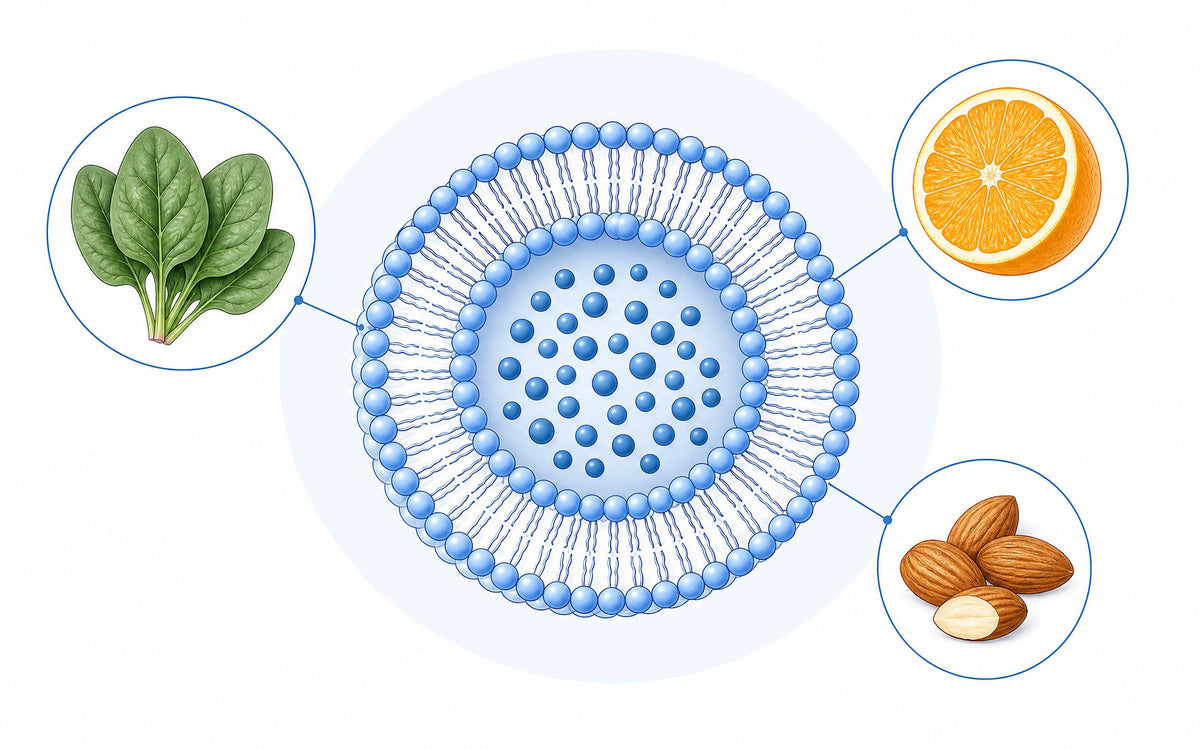
In liposomal vitamin C, the vitamin is enclosed in tiny spheres made of fat molecules, known as liposomes1. The vitamin itself is the same as in tablets or powder: only the form it comes in is different. You can find out how liposomes are put together in our article What are liposomes?
An older study shows why the form is worth a closer look. Seven healthy volunteers stayed in a clinic for four to six months and were given precisely controlled amounts of vitamin C3. A single dose of 200 mg was fully absorbed. From 500 mg per dose upwards, the proportion absorbed fell, and what was absorbed was excreted again3.
So more vitamin C per dose doesn’t automatically mean more in the blood. This is exactly where studies on liposomal forms come in: they test whether the shell changes the amount that ends up in the blood.
What does the 2025 review show?
A review screened 321 publications and found ten studies that compared liposomal with conventional vitamin C in people1. Seven of them were randomised crossover studies, in which each participant took both forms, one after the other. The author declares no conflicts of interest1.
In nine of the ten studies, more vitamin C reached the blood with the liposomal form. The peak level was 1.2 to 5.4 times as high, and the area under the curve (the amount over time) was 1.3 to 7.2 times as high1.
9 out of 10
comparison studies measured more vitamin C in the blood with the liposomal form1
+27%
higher peak level in blood plasma, in one study of 27 adults2
The range is wide because the studies differed a great deal: in the formulation, in the amount (0.15 to 10 g of vitamin C) and in how long blood samples were taken over (4 to 24 hours)1. As a result, the findings can hardly be compared directly1.
What exactly did one study involve?
In a study from 2024, 27 healthy adults (19 men and 8 women) each took a single dose on three occasions: a placebo, 500 mg of conventional vitamin C and 500 mg of liposomal vitamin C, all in identical-looking capsules2. The study was double-blind, which means that neither the participants nor the researchers knew which capsule was being taken. Blood samples were drawn eleven times over 24 hours2.
Compared with the placebo, both forms of vitamin C raised blood levels, and the rise was statistically significant. With the liposomal form, the peak level in blood plasma was 27% higher than with conventional vitamin C, and the amount over 24 hours was 21% higher. In white blood cells, the difference was 20% for the peak level and 8% over 24 hours2.
The study was funded by the manufacturer of the liposomal formulation being tested2. Another study, which was not blinded, found 1.77-fold bioavailability for the liposomal form. Both of its authors worked for companies in the industry4.
How do the studies relate to the immune system?
One of the authorised health claims for vitamin C reads: ‘Vitamin C contributes to the normal function of the immune system’. Vitamin C builds up in certain immune cells, such as neutrophil granulocytes5. In the older clinic study, white blood cells contained at least 14 times as much vitamin C as plasma3.
That’s why some newer studies measure white blood cells as well as plasma. According to the review, only two studies have done this so far. And only two have looked at possible effects on the body beyond blood levels1.
Good to know: the studies tested liposomal formulations from different manufacturers, which differed in structure and amount1. Blood levels were measured over 4 to 24 hours. The review author would like to see further studies that also look at excretion and include people whose levels are low to begin with1.
How should the evidence be judged overall?
The results point in a fairly consistent direction: with liposomal forms, more vitamin C reached the blood in almost all comparisons1. What remains open is how much of it the body keeps, and what that means beyond blood levels.
How liposomal vitamin C differs from buffered vitamin C and ascorbic acid is explained in our comparison of liposomal vitamin C, buffered vitamin C and ascorbic acid. Whichever form you choose, don’t take more than the recommended daily amount. Liposomal products from Melinava are manufactured to European pharmaceutical quality.
Frequently asked questions about liposomal vitamin C
What studies are there on liposomal vitamin C?
A 2025 review found ten studies in people that compared liposomal with conventional vitamin C. They mainly measured blood levels in the hours after a single dose. There’s hardly any data on excretion or on effects beyond blood levels1.
How does liposomal vitamin C work?
The vitamin is the same, but it’s enclosed in a shell made of fat molecules1. Studies test whether this gets more vitamin C into the blood, and found that it did in nine out of ten comparisons1. In the body, it does the same jobs as any other vitamin C. One authorised health claim, for example, is: ‘Vitamin C contributes to normal collagen formation for the normal function of skin’.
Are there studies on vitamin C and the immune system?
Yes, the role of vitamin C in immune cells is well researched5. For liposomal forms, studies so far mainly measure blood levels. The authorised health claim here is: ‘Vitamin C contributes to the normal function of the immune system’.
Sources
- Carr AC (2025). Do Liposomal Vitamin C Formulations Have Improved Bioavailability? A Scoping Review Identifying Future Research Directions. Basic & Clinical Pharmacology & Toxicology 137(1):e70067. DOI
- Purpura M, Jäger R, Godavarthi A, Bhaskarachar D, Tinsley GM (2024). Liposomal delivery enhances absorption of vitamin C into plasma and leukocytes: a double-blind, placebo-controlled, randomized trial. European Journal of Nutrition 63(8):3037-3046. DOI
- Levine M, Conry-Cantilena C, Wang Y, et al. (1996). Vitamin C pharmacokinetics in healthy volunteers: evidence for a recommended dietary allowance. Proceedings of the National Academy of Sciences 93(8):3704-3709. DOI
- Gopi S, Balakrishnan P (2021). Evaluation and clinical comparison studies on liposomal and non-liposomal ascorbic acid (vitamin C) and their enhanced bioavailability. Journal of Liposome Research 31(4):356-364. DOI
- Carr AC, Maggini S (2017). Vitamin C and Immune Function. Nutrients 9(11):1211. DOI
This article is for general information only and should not replace medical advice. Food supplements are not a substitute for a balanced and varied diet and a healthy lifestyle.
Written by
Melinava Editorial Team