
Your cart is empty

In this article
- Key points
- When should you take iron?
- Should you take iron in the morning or the evening?
- Should you take iron before or after meals?
- Why does vitamin C go well with iron?
- What if iron on an empty stomach doesn’t agree with you?
- When should you take liposomal iron?
- Frequently asked questions about taking iron
- Sources
Key points at a glance
- What the studies support: take iron in the morning with water or a drink that contains vitamin C, and keep it apart from breakfast, coffee and tea.
- Vitamin C increases iron absorption, so a glass of juice or a piece of fruit containing vitamin C goes well with it.
- Coffee, tea, milk and cheese taken at the same time can markedly reduce how much iron you absorb.
- If iron doesn’t agree with you on an empty stomach, you can take it with a small meal. Have your iron levels checked by your doctor before you start.
Iron contributes to normal oxygen transport in the body1. Bioavailability describes how much of the iron in a capsule or in drops actually reaches your blood. With iron, that depends heavily on when you take it and what you take it with. So the everyday question ‘when should I take it?’ really does matter, and there are precise measurements in humans that answer it.
When should you take iron?
The short answer: in the morning, with water or a drink containing vitamin C, and away from breakfast and coffee. That’s what many recommendations say, but for a long time there was hardly any direct evidence for it2.
A study from 2023 therefore put these points to the test. In it, 34 women with low iron stores each took 100 mg of iron under six different conditions2.
That the time of day matters at all is down to hepcidin. This hormone, made by the body itself, slows down the absorption of iron in the gut. After a larger dose of iron (from about 60 mg), hepcidin rises, stays raised for about 24 hours and has fallen again after 48 hours3. In the 2023 study, hepcidin was also higher in the afternoon than in the morning2.
Should you take iron in the morning or the evening?
In the 2023 study, the women absorbed 37% less iron in the afternoon than in the morning. This difference narrowly missed statistical significance, but the researchers still recommend the morning2. A review by the same research group also advises against taking a second dose in the afternoon or evening after a morning dose3.
Splitting the dose didn’t help either. Two doses of 60 mg (morning and afternoon) led to no more absorbed iron than a single 120 mg dose in the morning, but hepcidin rose more4. In another trial, women took 14 doses of 60 mg each, either daily or every other day. On alternate days, they absorbed more iron in total, on average 175 mg instead of 131 mg4.
One important caveat: these studies used high amounts of 60 to 120 mg per dose and looked at small groups of women with low iron stores2,4. Whether the differences are just as large at lower amounts is still an open question.
Should you take iron before or after meals?
Here, the measurements are clear. A cup of coffee taken with the iron reduced absorption by 54%. A breakfast with coffee and orange juice reduced it by as much as 66%, even though the juice contained vitamin C2.
54%
less iron was absorbed when it was taken with a cup of coffee2.
30%
more iron was absorbed when 80 mg of vitamin C was added2.
Calcium has an inhibiting effect too. In an older study, 165 mg of calcium from milk or cheese reduced the absorption of iron from a meal by 50 to 60%5.
With coffee, timing matters too. In a study with meals, coffee didn’t interfere with iron absorption when it was drunk one hour before the meal. Drunk one hour after the meal, it inhibited absorption just as much as when it was taken with the meal. In the same study, tea had an even stronger inhibiting effect than coffee6.
This study didn’t give an exact waiting time, and it looked at iron from food, not from a supplement. As a rule of thumb for everyday life: drink your coffee one hour before your iron rather than soon after it, and once you’ve taken your iron, leave a gap before you have coffee, tea or dairy products. There’s more on this in our article on coffee and food supplements.
Why does vitamin C go well with iron?
Vitamin C increases iron absorption. This is an authorised health claim1. In the 2023 study, 80 mg of vitamin C increased absorption by 30%, while 500 mg brought no further increase2. How the two work together is explained in our article on taking vitamin C and iron together.
What if iron on an empty stomach doesn’t agree with you?
Taken without food, iron upsets some people’s stomachs. Particularly at high amounts, iron that the body doesn’t absorb can irritate the gut, and some people stop taking it for that reason3. In that case, a small meal without dairy products, coffee or tea is a sensible compromise. What matters is a way of taking it that suits you and that you can keep up in the long term.
When should you take liposomal iron?
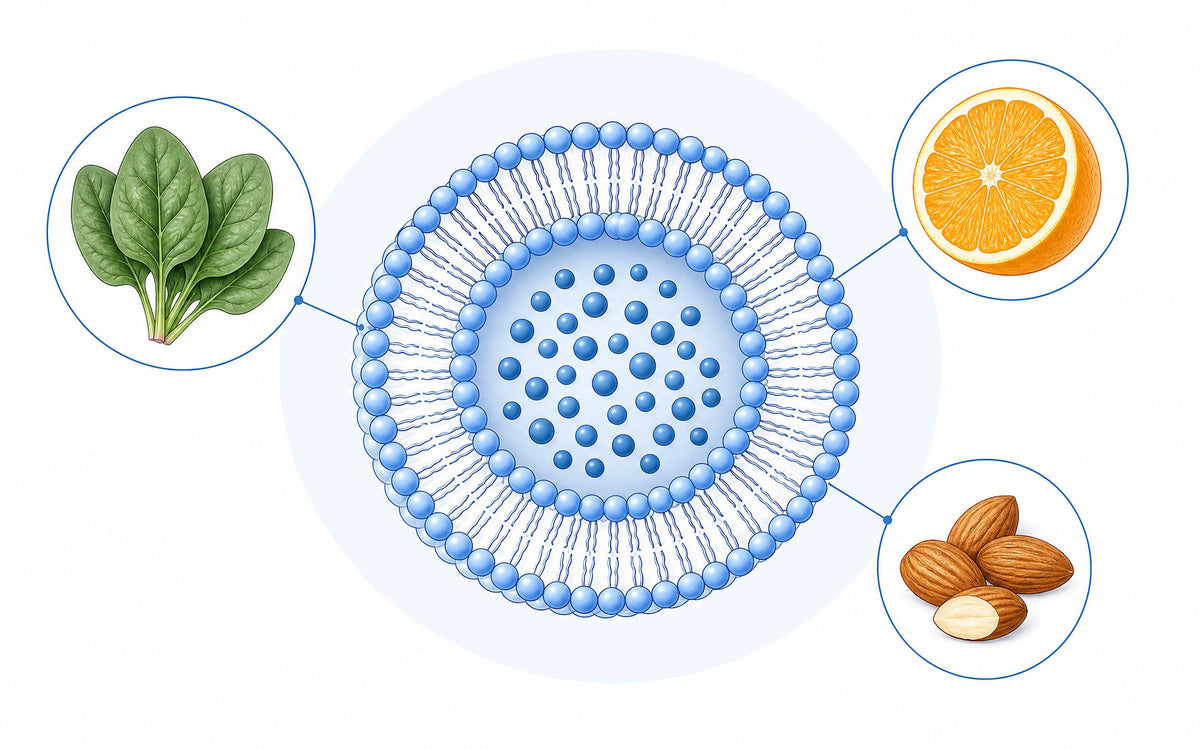
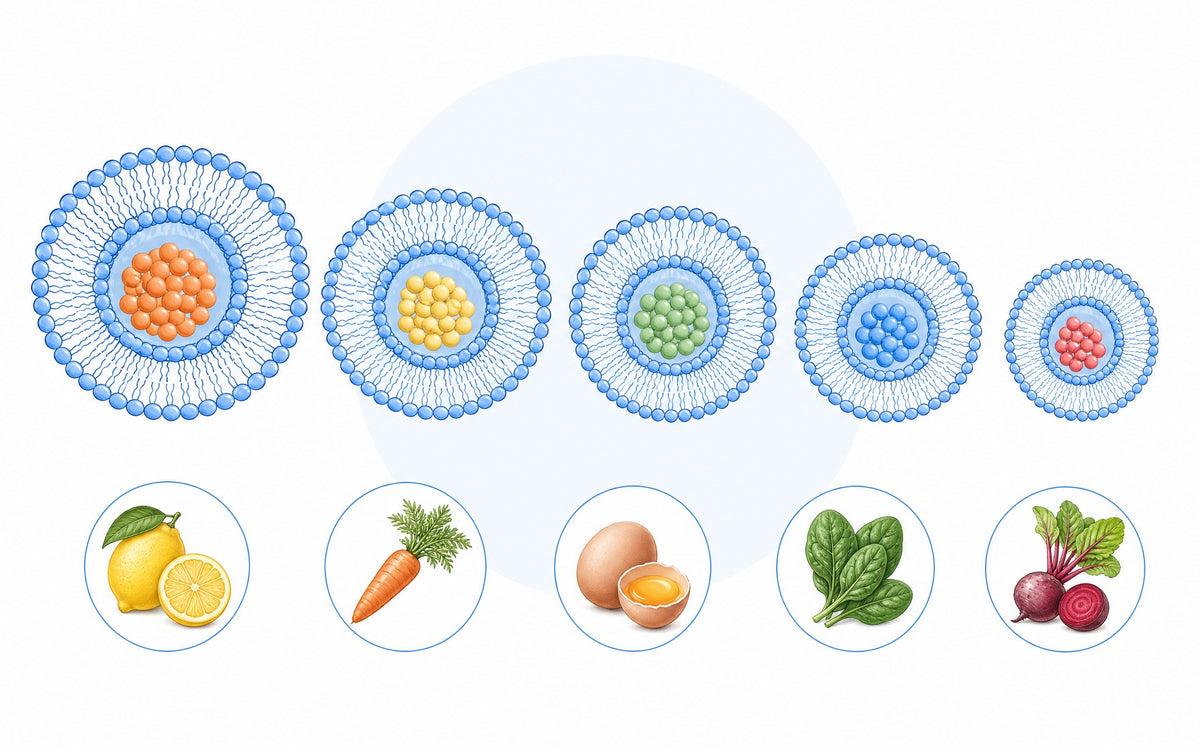
The studies above looked at conventional iron salts. In liposomal iron, the iron is enclosed in tiny vesicles made of phospholipids. We found no studies on the timing of intake for this form specifically. So the basic rules are a good guide: in the morning, away from coffee, tea and dairy products, and as directed on the pack.
You can find out more about this form in our article on liposomal iron. For our liposomal products, we use phospholipids from European sunflowers.
Good to know: Don’t start taking iron just because you suspect you’re low. Have your iron levels checked by your doctor first. If you take any medicines, get medical advice before you start. And don’t take more than the recommended daily amount.
Frequently asked questions about taking iron
Should I take iron in the morning or in the evening?
Preferably in the morning. In one study, women absorbed less iron in the afternoon, and the hormone hepcidin, which slows absorption, was higher2. If the evening is the only time that fits your daily routine, keep a gap between your iron and your evening meal, tea and dairy products.
Should I take iron before or after meals?
Ideally away from meals. In one study, a breakfast with coffee reduced absorption by 66%2. If you don’t tolerate iron on an empty stomach, take it with a small meal without milk, coffee or tea.
When should I take liposomal iron?
We aren’t aware of any studies on timing for this form specifically. Follow the directions on the pack and the basic rules: in the morning, and away from coffee, tea and dairy products.
Sources
- European Commission (2012). Commission Regulation (EU) No 432/2012 of 16 May 2012 establishing a list of permitted health claims made on foods, other than those referring to the reduction of disease risk and to children’s development and health. Official Journal of the European Union L 136, 25.5.2012, p. 1. Link
- von Siebenthal HK, Moretti D, Zimmermann MB, Stoffel NU (2023). Effect of dietary factors and time of day on iron absorption from oral iron supplements in iron deficient women. American Journal of Hematology 98(9):1356-1363. DOI
- Stoffel NU, von Siebenthal HK, Moretti D, Zimmermann MB (2020). Oral iron supplementation in iron-deficient women: How much and how often? Molecular Aspects of Medicine 75:100865. DOI
- Stoffel NU, Cercamondi CI, Brittenham G, et al. (2017). Iron absorption from oral iron supplements given on consecutive versus alternate days and as single morning doses versus twice-daily split dosing in iron-depleted women: two open-label, randomised controlled trials. The Lancet Haematology 4(11):e524-e533. DOI
- Hallberg L, Brune M, Erlandsson M, Sandberg AS, Rossander-Hultén L (1991). Calcium: effect of different amounts on nonheme- and heme-iron absorption in humans. The American Journal of Clinical Nutrition 53(1):112-119. DOI
- Morck TA, Lynch SR, Cook JD (1983). Inhibition of food iron absorption by coffee. The American Journal of Clinical Nutrition 37(3):416-420. DOI
This article is for general information only and should not replace medical advice. Food supplements are not a substitute for a balanced and varied diet and a healthy lifestyle.
Written by
Melinava Editorial Team