

Your cart is empty

In this article
Key points at a glance
- Why is vitamin C important for skin? Vitamin C contributes to normal collagen formation for the normal function of skin. This is an authorised health claim.
- Your skin holds a lot of vitamin C, and it reaches the deeper layers through the blood.
- A serum works from the outside. Whether it actually gets vitamin C into the skin depends largely on how it’s formulated.
- Serum and capsules aren’t an either/or. Choose the route you can stick with day to day.
Vitamin C has long been a favourite for skin, whether in the bathroom cabinet or in the kitchen. It does matter, though, whether you put it on your skin or take it in through food and supplements. If you’ve ever wondered whether a serum or a supplement makes more sense, this article explains what’s behind each route and how to find the one that suits you.
Why does skin need vitamin C?
Vitamin C is essential: your body can’t make it, so it has to come from food1. For skin there is an authorised health claim, which reads: ‘Vitamin C contributes to normal collagen formation for the normal function of skin’2.
Healthy skin contains a lot of vitamin C, considerably more than blood plasma3. Good food sources are fruit and vegetables such as peppers, citrus fruit, kiwi fruit and broccoli.
How does vitamin C get into the skin?
Skin is made up of two layers: the outer epidermis and, beneath it, the dermis. Only the dermis has blood vessels, so the epidermis gets its nutrients from below, from the dermis3.
From the outside, the route is harder. The outermost layer of the skin (the stratum corneum) keeps out water and many other substances. The authors of a review consider it unlikely that nutrients applied to the skin readily reach the deeper layers of the dermis. Their conclusion: the dermis is better supplied through the blood3.
Vitamin C serum: what’s in it?
Serums contain vitamin C either as pure ascorbic acid or in a modified form known as a derivative. Derivatives were developed with the aim of making vitamin C more stable in cosmetics and helping it get into the skin more easily4.
In an experiment on pig skin, ascorbic acid only penetrated when the preparation was very acidic, with a pH below 3.5. In this experiment, the three derivatives tested did not raise the ascorbic acid content of the skin. The authors conclude that with vitamin C applied to the skin, the formulation is what matters most5.
According to the review mentioned above, it’s still largely unclear whether vitamin C applied to the skin offers more benefit than a good intake from your diet3. Keep a vitamin C serum cool, dark and tightly closed, because ascorbic acid is sensitive to oxygen3.
Vitamin C from food and supplements: what matters?
Vitamin C from food and from supplements passes from the gut into the blood. Skin cells actively take it up from there and concentrate it3.
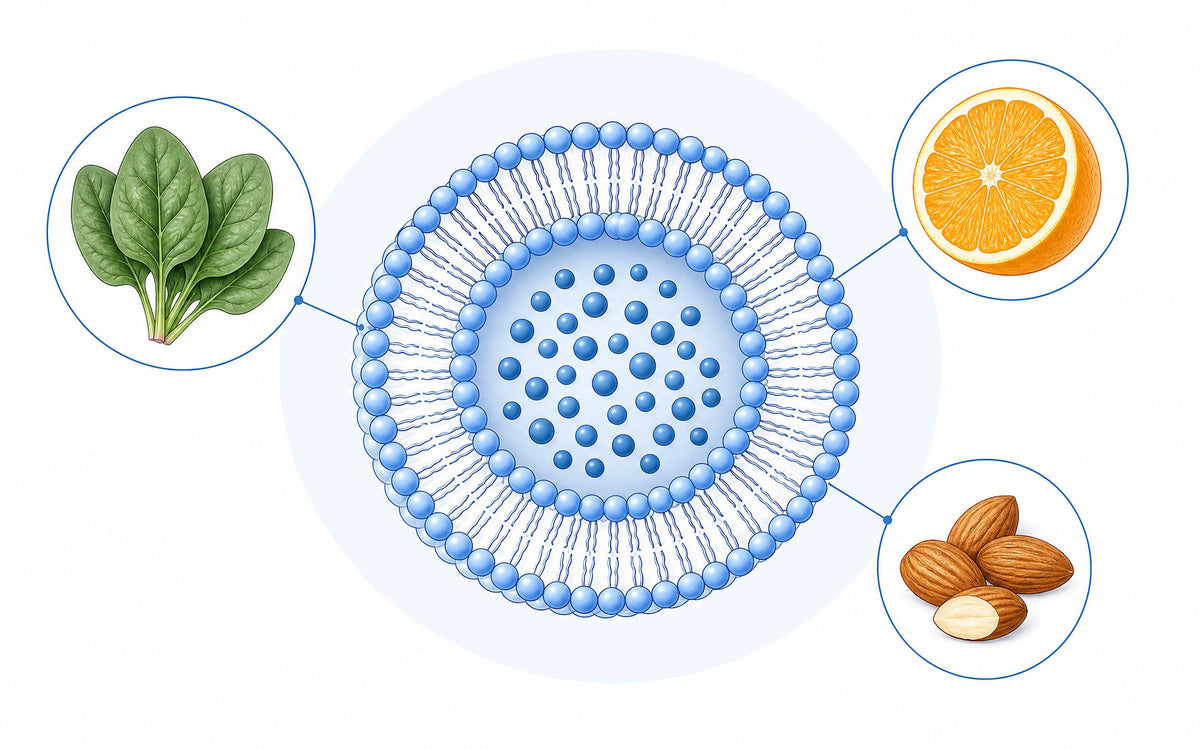
Supplements come as ascorbic acid, in a buffered form or in a liposomal form. Our article on liposomal, buffered and standard vitamin C explains the differences.
A review looked at ten human studies comparing liposomal with conventional vitamin C. In nine of them, vitamin C levels in the blood were higher with the liposomal form, although the formulations and doses varied widely1. What was measured was bioavailability in the blood, not the vitamin C content of the skin. You can read more in our article on what the research on liposomal vitamin C shows.
Good to know: The authorised health claim on vitamin C and skin applies to vitamin C from food, and that includes supplements2. Cosmetics such as serums are covered by their own rules. The studies on liposomal vitamin C were carried out with formulations from other manufacturers.
Serum or capsules: how to decide
The two routes work in different places. The points below can help you choose.
- Route: a capsule supplies your body through the blood, while a serum works from the outside, on the surface of the skin.
- Skin feel: for pure ascorbic acid to get into the skin, the preparation has to be very acidic5. If your skin is sensitive, patch-test a new serum on a small area first.
- Effort involved: you take a capsule with the same meal every time, while a serum becomes part of your morning or evening skincare routine.
- Storage: keep capsules cool and dry; a serum needs a dark place and a cap that closes tightly.
- Combining both: you don’t have to choose one or the other.
Don’t take more than the recommended daily amount. If you take any medicines, check with your doctor first.
Frequently asked questions about vitamin C for skin
What does vitamin C do for skin?
For vitamin C from food and supplements, the authorised health claim applies: ‘Vitamin C contributes to normal collagen formation for the normal function of skin’. With a serum, whether any vitamin C reaches the skin at all depends largely on the formulation5.
Is there any point in taking vitamin C for your skin?
Vitamin C contributes to normal collagen formation for the normal function of skin. Vitamin C you take in reaches the skin through the blood, which is the same route by which skin normally gets its nutrients3.
Which form of vitamin C is right for your skin?
There’s no single form that suits everyone equally well. As a supplement, you can choose between ascorbic acid, buffered and liposomal forms. With serums, the formulation matters most5. For our liposomal products, we use phospholipids from European sunflowers.
Sources
- Carr AC (2025). Do Liposomal Vitamin C Formulations Have Improved Bioavailability? A Scoping Review Identifying Future Research Directions. Basic & Clinical Pharmacology & Toxicology 137(1):e70067. DOI
- European Commission (2012). Commission Regulation (EU) No 432/2012 of 16 May 2012 establishing a list of permitted health claims made on foods, other than those referring to the reduction of disease risk and to children’s development and health. Link
- Pullar JM, Carr AC, Vissers MCM (2017). The Roles of Vitamin C in Skin Health. Nutrients 9(8):866. DOI
- Enescu CD, Bedford LM, Potts G, Fahs F (2022). A review of topical vitamin C derivatives and their efficacy. Journal of Cosmetic Dermatology 21(6):2349-2359. DOI
- Pinnell SR, Yang H, Omar M, et al. (2001). Topical L-ascorbic acid: percutaneous absorption studies. Dermatologic Surgery 27(2):137-142. DOI
This article is for general information only and should not replace medical advice. Food supplements are not a substitute for a balanced and varied diet and a healthy lifestyle.
Written by
Melinava Editorial Team