

Your cart is empty

In this article
Key points at a glance
- Iron drops or capsules? What matters more than the form is which iron compound is inside and how well you tolerate it.
- In studies, ferrous sulfate, the classic iron salt, caused digestive side effects markedly more often than a placebo1.
- In liposomal iron, the iron is enclosed in liposomes. In one study with 25 healthy adults, iron levels in the blood rose more with it than with a conventional preparation at the same dose2.
- Before you take iron, ask your doctor to check your iron levels.
What does the body need iron for?
Iron contributes to normal formation of red blood cells and haemoglobin. Iron contributes to normal oxygen transport in the body, and iron contributes to the reduction of tiredness and fatigue3. These authorised health claims apply to iron itself, whatever form it comes in: no form has a claim of its own.
Iron is unusual in one respect: the body has no active way of getting rid of excess iron. It controls its iron balance solely through how much it absorbs from the gut4. So if you suspect a deficiency, have your iron levels checked by your doctor before you take iron.
Which forms of iron are there?
In the EU, many iron compounds are approved for use in food supplements, including ferrous sulfate, ferrous gluconate, ferrous fumarate, iron bisglycinate and ferric pyrophosphate5. The one prescribed most often is ferrous sulfate, a simple iron salt6. There are also forms in which the iron is coated, such as sucrosomial iron6 and liposomal iron2.
Drops or capsules is a separate question: it concerns the dosage form. Either can contain very different iron compounds, so the ingredients list tells you more than whether it comes as drops or capsules.
How well are iron tablets tolerated?
An analysis of 43 studies with 6,831 adults looked at how well ferrous sulfate is tolerated. In the 20 studies with a placebo group, ferrous sulfate caused digestive side effects markedly more often than placebo1. The researchers found no link with the size of the dose1.
According to another review, up to 50% of people taking iron salts report digestive side effects, and some no longer take their supplement regularly as a result7. This is where newer forms that coat the iron come in.
What is liposomal iron?
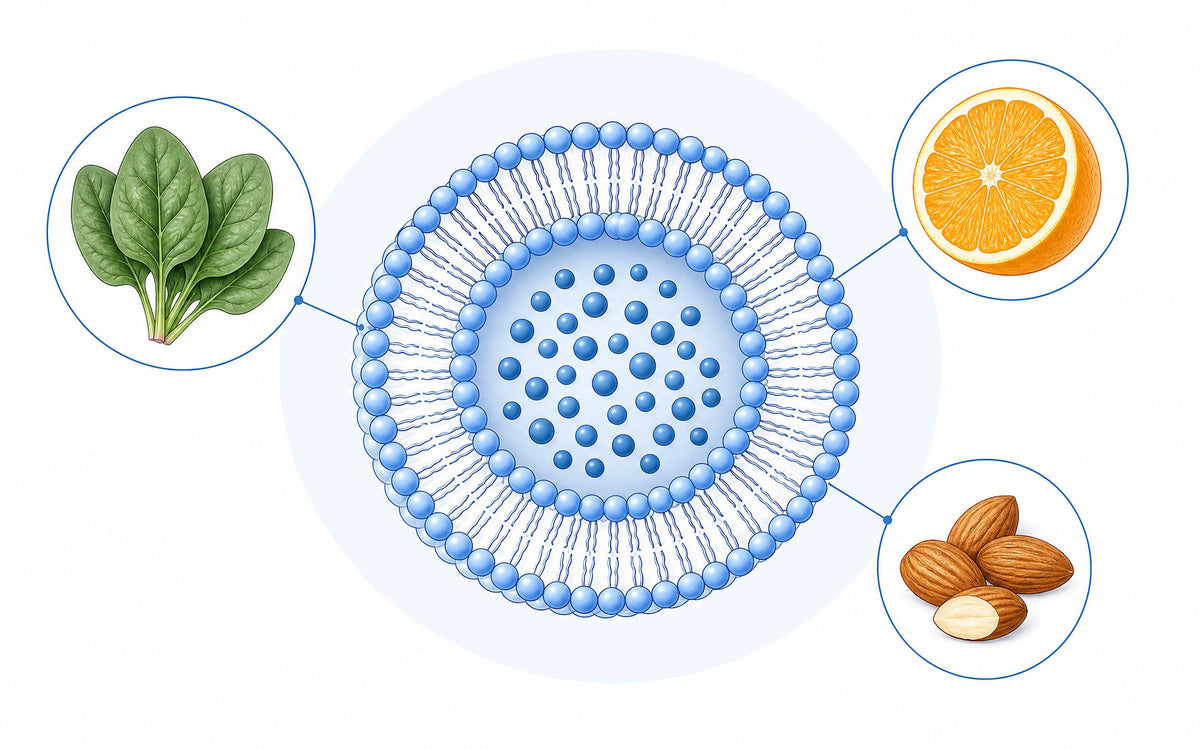
In liposomal iron, the iron compound is enclosed in liposomes, tiny vesicles made of phospholipids. Shells like these can protect their contents on the way through the digestive tract8. You can read more in our article on liposomal iron and how it works.
In one study, 25 healthy adults took a liposomal preparation on one occasion and a conventional preparation at the same dose on another, both containing vitamins and minerals and about 10 mg of iron. Four hours later, the level of iron in the blood was 14% above the starting level with the liposomal form, while with the conventional preparation it was 6% below2. Over six hours, the average rise with the liposomal form was 50% greater2.
The study was small, looked at a single dose and was funded by a food supplement manufacturer2. It shows how much iron reaches the blood in the hours after a dose.
Liposomal or sucrosomial: what’s the difference?
Both approaches coat the iron. In sucrosomial iron, ferric pyrophosphate sits in a phospholipid bilayer and is also wrapped in a shell of sucrose esters (sugar esters)7. Sucrosomial is the brand name of an ingredient. ‘Liposomal’, by contrast, describes a principle, not a particular raw material.
The review on sucrosomial iron mentioned above was written with the involvement of employees of the manufacturer7. Whichever of the two forms you’re considering, check which iron compound is inside.
Drops or capsules: the case for each
Choosing between drops and capsules is mostly about what suits your everyday life:
- Capsules have no taste, are precisely dosed and are easy to carry with you when you’re out and about. Liposomal iron is available as capsules too.
- Drops and liquids (such as tonics or syrups) make the dose easy to adjust and suit people who find capsules hard to swallow.
What you eat and drink at the same time also affects absorption. Certain substances in food influence how much iron is absorbed, for example phytate, polyphenols and calcium4. Your own iron status has an even greater influence than your diet4. What this means for coffee and tea is covered in our article on coffee and food supplements.
Vitamin C increases iron absorption3. Why the two are often taken together is explained in our article on taking vitamin C and iron together. For more on the time of day, see our article on when to take iron: morning, evening or with a meal.
If you take any medicines, check with your doctor first. Do not exceed the recommended daily amount.
At Melinava, we use phospholipids from European sunflowers for our liposomal products.
Frequently asked questions about iron drops and capsules
Iron drops or capsules: which is better?
Neither form is better as such. Capsules have no taste and are easy to carry with you, while with drops the dose is easy to adjust. What matters more is which iron compound is inside and how well you tolerate it.
What’s the difference between liposomal and sucrosomial iron?
Both coat the iron with phospholipids. Sucrosomial iron also has a shell of sucrose esters (sugar esters)7.
Is liposomal iron also available as capsules?
Yes. Liposomal iron comes as capsules and in liquid form. ‘Liposomal’ describes the coating; the capsule is just the dosage form.
Can I just take iron as a precaution?
Ask your doctor to check your iron levels first. The body has no active way of getting rid of excess iron4.
Sources
- Tolkien Z, Stecher L, Mander AP, Pereira DI, Powell JJ (2015). Ferrous sulfate supplementation causes significant gastrointestinal side-effects in adults: a systematic review and meta-analysis. PLoS One 10(2):e0117383. DOI
- Tinsley GM, Harty PS, Stratton MT, Siedler MR, Rodriguez C (2022). Liposomal Mineral Absorption: A Randomized Crossover Trial. Nutrients 14(16):3321. DOI
- European Commission (2012). Commission Regulation (EU) No 432/2012 of 16 May 2012 establishing a list of permitted health claims made on foods, other than those referring to the reduction of disease risk and to children’s development and health (consolidated version of 20 August 2025). Link
- Hurrell R, Egli I (2010). Iron bioavailability and dietary reference values. The American Journal of Clinical Nutrition 91(5):1461S-1467S. DOI
- European Parliament and Council of the European Union (2002). Directive 2002/46/EC on food supplements, Annex II (consolidated version of 26 November 2025). Link
- Pantopoulos K (2024). Oral iron supplementation: new formulations, old questions. Haematologica 109(9):2790-2801. DOI
- Gómez-Ramírez S, Brilli E, Tarantino G, Muñoz M (2018). Sucrosomial® Iron: A New Generation Iron for Improving Oral Supplementation. Pharmaceuticals 11(4):97. DOI
- Daeihamed M, Dadashzadeh S, Haeri A, Akhlaghi MF (2017). Potential of Liposomes for Enhancement of Oral Drug Absorption. Current Drug Delivery 14(2):289-303. DOI
This article is for general information only and should not replace medical advice. Food supplements are not a substitute for a balanced and varied diet and a healthy lifestyle.
Written by
Melinava Editorial Team