

Your cart is empty

In this article
The key points
- Liposomes wrap a nutrient in a shell that can protect it on its way through the digestive tract. For vitamin C, coenzyme Q10 and iron, studies in people have measured higher blood levels with this form.
- Whether the liposomal form makes a difference depends on the nutrient. There’s no single answer that covers every product.
- The word ‘liposomal’ tells you the form an ingredient comes in, not how much of it is in each dose.
- Our verdict: partly true. For well-researched nutrients there are clear measurements; for the rest, the evidence has to be checked nutrient by nutrient.
Where does the idea that liposomal is better come from?
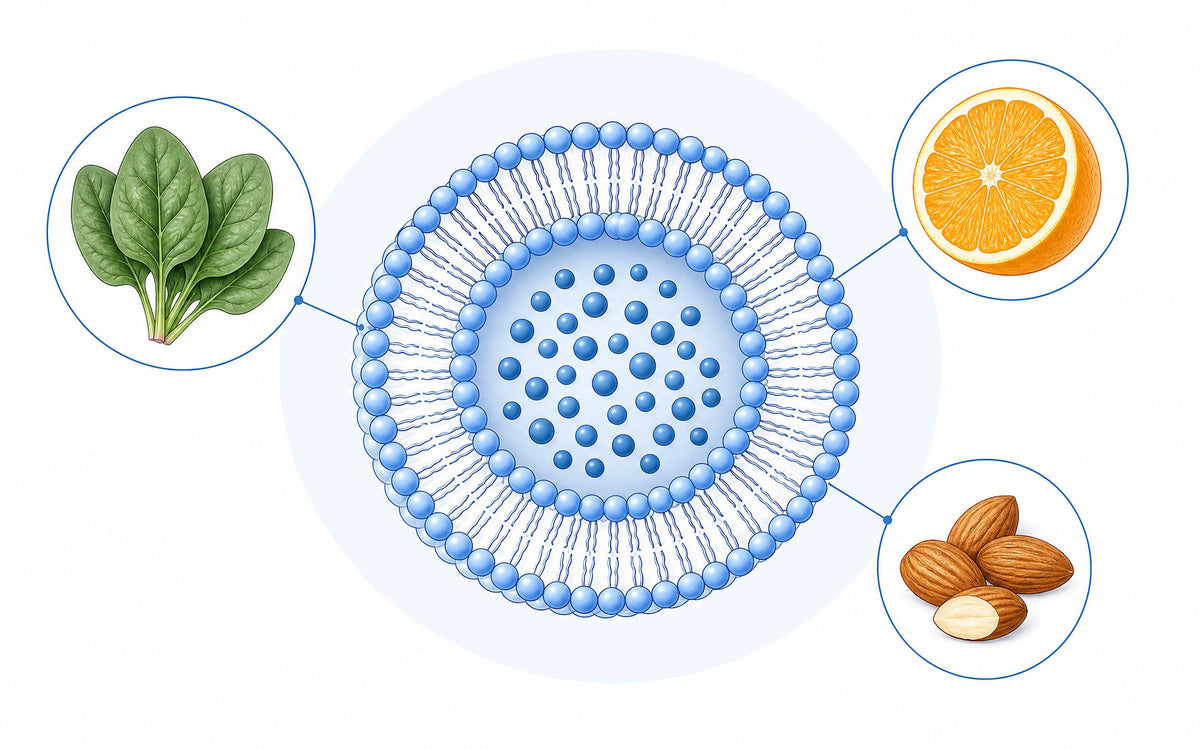
You’ll see ‘liposomal’ on a lot of labels these days, often with the promise that your body absorbs the ingredient better. A liposome is a tiny bubble whose outer layer resembles the membranes of our own cells1. Water-soluble substances such as vitamin C sit in its watery core, while fat-soluble ones such as coenzyme Q10 are held in the outer layer1.
This layer can protect what’s inside as it passes through the digestive tract and can improve contact with the lining of the gut2. How stable liposomes actually remain in the stomach and intestines, however, is seen as one of the key unanswered questions1,2. So whether more ends up in the blood can’t be worked out from theory alone. It can only be measured in people.
How liposomes are built and what happens to them during digestion is explained in our article What are liposomes?
What do the studies show for vitamin C?
For vitamin C there are several direct comparisons. One review found ten studies in people that compared liposomal vitamin C with the conventional form. In nine of them, bioavailability was higher with the liposomal form3. The formulations, doses and measurement periods varied a great deal, though3.
In one of these studies, 27 healthy adults took a single 500 mg dose of vitamin C, either in a conventional or in a liposomal capsule. With the liposomal form, the peak level in blood plasma was 27% higher, and 21% higher when measured over 24 hours. White blood cells also contained more vitamin C4.
9 out of 10
comparison studies measured higher bioavailability with liposomal vitamin C3
27%
higher peak level in blood plasma with liposomal vitamin C, at the same 500 mg dose4
We look at the individual studies in detail in our article Liposomal vitamin C: what the evidence shows.
And what about coenzyme Q10 and iron?
Coenzyme Q10 dissolves poorly in water, which limits how well it’s absorbed. In a study of 18 healthy adults taking 100 mg each, the peak blood level was 31% higher with the liposomal form, and 23% higher when measured over 24 hours5.
For iron, a study of 25 healthy adults compared a liposomal multivitamin-mineral product with a conventional one at the same dose. With the liposomal form, blood iron levels rose more: the area under the curve was on average 50% larger6. You can read more in our article Liposomal iron: what’s behind this form?
‘Liposomal’ describes the delivery form, not the dose
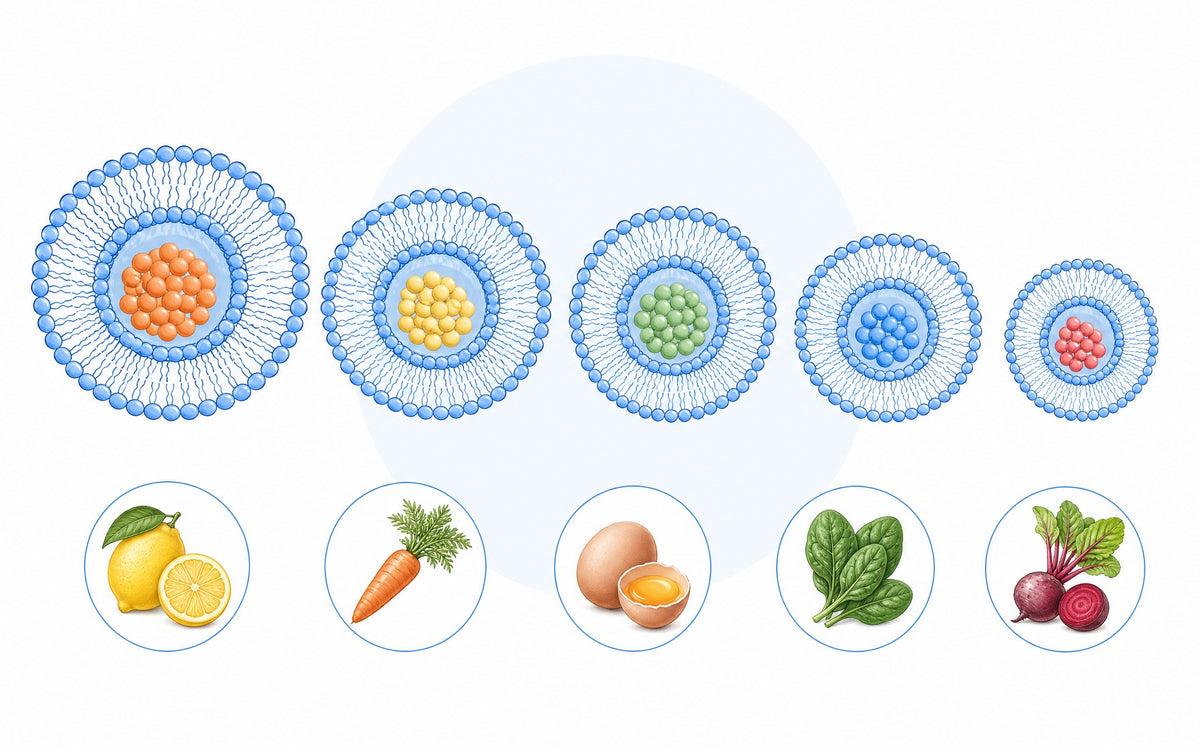
‘Liposomal’ tells you the form an ingredient comes in. It says nothing about how much of it is in each dose. Two liposomal products can therefore contain quite different amounts, just like two conventional ones.
A larger amount doesn’t automatically mean more in the blood. In a study of seven healthy volunteers, the body fully absorbed a single 200 mg dose of vitamin C. At single doses of 500 mg and above, the proportion absorbed fell, and the vitamin C the body had absorbed was excreted in the urine7. So the figure on the label tells you little on its own about what actually reaches your body.
Good to know: These studies have their limits. Most involved a small number of healthy adults given a single dose, with blood levels measured over a few hours. All the vitamin C studies in the review were funded by industry or had authors employed by companies. The two studies on vitamin C and coenzyme Q10 were funded by the manufacturer of the formulation being tested3,4,5. These studies don’t tell us whether higher blood levels make any difference to how people feel.
‘Liposomal is better’: our verdict, partly true
As a blanket judgement on every product, ‘liposomal is better’ isn’t true. As an observation about certain nutrients, it is: for vitamin C, coenzyme Q10 and iron, studies in people measured higher blood levels with liposomal forms3,5,6. For other nutrients, it’s worth looking at the evidence one by one.
What the absorption promises in advertising really mean is covered in our article ‘Best absorbed’: what’s behind the promise. The studies mentioned here were carried out with other manufacturers’ formulations, not with products from Melinava. For our liposomal products, we use phospholipids from European sunflowers.
Frequently asked questions about liposomal vitamins
Why is liposomal vitamin C better?
It depends on what’s being measured. In nine out of ten comparison studies, bioavailability was higher with liposomal vitamin C than with the conventional form3. Only a few studies have so far looked at what this means for the body. Do not exceed the recommended daily amount.
Liposomal or not: what’s the difference?
In a liposomal form, the ingredient is enclosed in tiny bubbles made of phospholipids; in a conventional form, it isn’t enclosed in anything. The amount can be the same in both. Whether absorption differs can only be shown by measurements in people, and separately for each nutrient.
Are liposomal vitamins better?
For vitamin C, several comparison studies have found higher blood levels3. For every other vitamin, it’s worth looking at the evidence one by one. Our overview of liposomal vitamins shows which liposomal vitamins are available.
Sources
- He H, Lu Y, Qi J, Zhu Q, Chen Z, Wu W (2019). Adapting liposomes for oral drug delivery. Acta Pharmaceutica Sinica B 9(1):36-48. DOI
- Daeihamed M, Dadashzadeh S, Haeri A, Akhlaghi MF (2017). Potential of Liposomes for Enhancement of Oral Drug Absorption. Current Drug Delivery 14(2):289-303. DOI
- Carr AC (2025). Do Liposomal Vitamin C Formulations Have Improved Bioavailability? A Scoping Review Identifying Future Research Directions. Basic & Clinical Pharmacology & Toxicology 137(1):e70067. DOI
- Purpura M, Jäger R, Godavarthi A, Bhaskarachar D, Tinsley GM (2024). Liposomal delivery enhances absorption of vitamin C into plasma and leukocytes: a double-blind, placebo-controlled, randomized trial. European Journal of Nutrition 63(8):3037-3046. DOI
- Jäger R, Purpura M, Godavarthi A, et al. (2025). Impact of liposomal delivery on coenzyme Q10 absorption: a double-blind, placebo-controlled, randomized trial. Frontiers in Nutrition 12:1605033. DOI
- Tinsley GM, Harty PS, Stratton MT, Siedler MR, Rodriguez C (2022). Liposomal Mineral Absorption: A Randomized Crossover Trial. Nutrients 14(16):3321. DOI
- Levine M, Conry-Cantilena C, Wang Y, et al. (1996). Vitamin C pharmacokinetics in healthy volunteers: evidence for a recommended dietary allowance. Proceedings of the National Academy of Sciences 93(8):3704-3709. DOI
This article is for general information only and should not replace medical advice. Food supplements are not a substitute for a balanced and varied diet and a healthy lifestyle.
Written by
Melinava Editorial Team