

Your cart is empty

In this article
In short
- Turmeric with black pepper isn’t a random pairing: piperine from black pepper slows down the body’s breakdown of curcumin, and in one study this meant considerably more curcumin reached the blood.
- Turmeric is a plant, and also the spice made from its rhizome (the underground stem). Curcumin is its most important plant compound.
- On its own, curcumin is poorly absorbed into the blood, because it barely dissolves in water and is broken down quickly.
- Besides piperine, there are other approaches, such as liposomal forms. There’s no authorised health claim for turmeric in the UK or the EU.
Turmeric and curcumin: what’s the difference?
Turmeric (Curcuma longa) is a perennial plant from the ginger family. The spice made from its rhizome is also called turmeric. Its most important natural plant compound is curcumin, a type of polyphenol1.
Strictly speaking, turmeric contains several closely related compounds, known as curcuminoids: curcumin, demethoxycurcumin and bisdemethoxycurcumin2. Extracts contain these curcuminoids in concentrated form, and studies have used extracts with 95% curcuminoids, for example1.
Piperine, on the other hand, isn’t part of turmeric. It’s the main active compound in black pepper1.
Why does so little curcumin reach the blood?
Curcumin has low bioavailability. A review gives three reasons: the gut absorbs it poorly, the body converts (metabolises) it quickly, and the body excretes it again quickly3. On top of that, curcumin barely dissolves in water2.
A study from 1998 shows how pronounced this is: after 2 g of curcumin on its own, the volunteers’ blood levels were either undetectable or very low4. The authors put the rapid conversion down to the liver and the intestinal wall4.
Turmeric with black pepper: what’s behind it?
In the liver and the intestinal wall, piperine inhibits a breakdown pathway the body uses to convert curcumin4. That’s why, in the 1998 study, volunteers were also given 2 g of curcumin together with 20 mg of piperine. In the first hour, their blood levels were then considerably higher, and bioavailability rose by 2,000%4.
The study only looked at a single dose, but reviews still cite it today1. Piperine affects breakdown pathways in the liver and gut, so if you take any medicines, check with your doctor before taking turmeric with black pepper.
Liposomal and other forms: what are the options?
Piperine is just one way to improve how well curcumin is absorbed. A review names others: liposomal curcumin, curcumin nanoparticles and complexes of curcumin with phospholipids3. A crossover study in healthy volunteers shows how much the formulation matters: depending on the product, different amounts of curcuminoids reached the blood, in some cases several times as much as from a standard extract2.
There’s also a more recent study of a liposomal form. In it, 18 healthy men were given a single dose of either curcumin in liposomes with an extra protective coating, or free curcumin. Adjusted to the same amount, the area under the curve was 23 times as large with the liposomal form, and the peak level 53 times as high5. The groups were small, with nine men in each, and the study only looked at a single dose taken on an empty stomach5.
2,000%
Higher bioavailability of curcumin with 20 mg of piperine, in a study from 19984
23×
Area under the curve with a liposomal form, adjusted to the same amount5
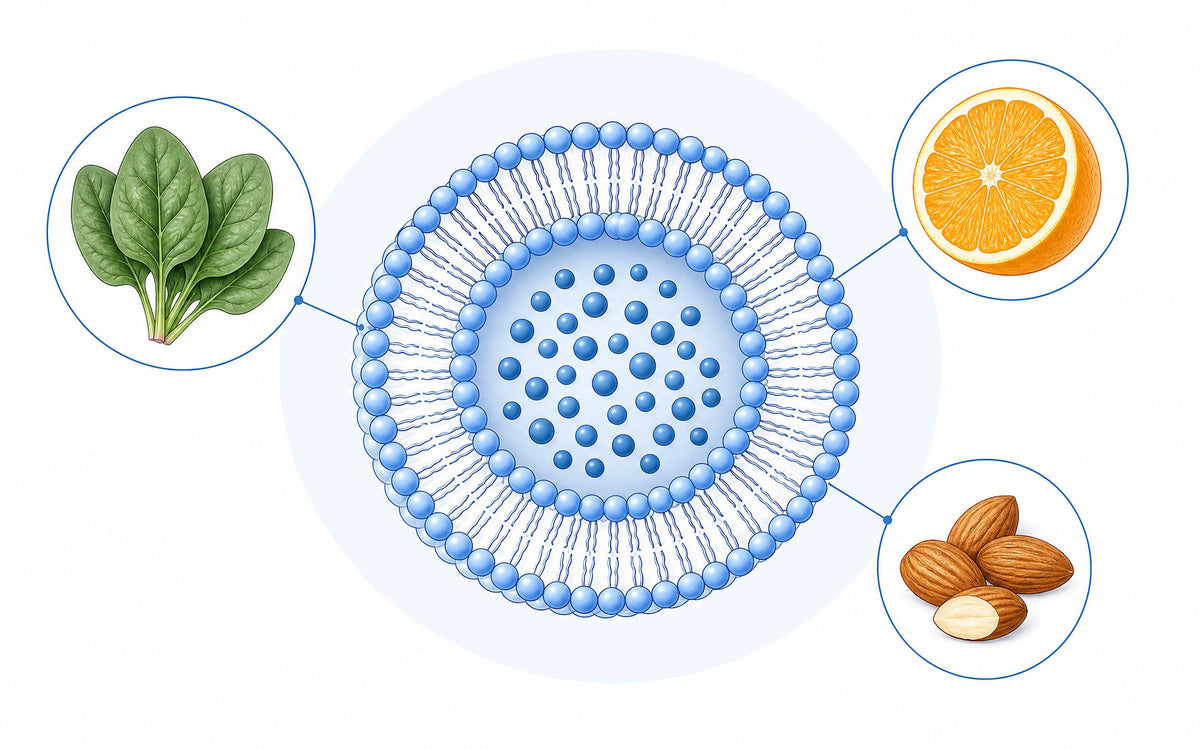
For our liposomal products, we use phospholipids from European sunflowers. You can find out what liposomes are in our article What are liposomes?
Taking turmeric: when, and how much?
There’s no authorised health claim for turmeric or curcumin in the UK or the EU. Studies have used very different amounts, from 400 mg of curcumin in liposomal form up to 2 g of free curcumin4,5. Follow the directions on the pack. Do not exceed the recommended daily amount.
For practical tips on whether to take it in the morning or evening, on an empty stomach or with food, see our article Morning or evening? When to take supplements, from ashwagandha to turmeric.
Frequently asked questions about turmeric and piperine
Do I have to take turmeric with black pepper?
No. Piperine is one way to improve how well curcumin is absorbed. Liposomal forms and complexes with phospholipids are others3. Which form you choose also comes down to personal preference.
What is liposomal curcumin?
Liposomal curcumin is enclosed in liposomes, tiny vesicles made of phospholipids. In a small study of 18 men, considerably more curcumin reached the blood with it than with free curcumin5. How liposomal and micellar forms differ is explained in our comparison Micellar or liposomal: the two forms compared.
How much turmeric should I take?
That depends on the product, because extracts and forms vary widely. What matters isn’t only the amount on the label, but also how much of it reaches the blood2. Our article Bioavailability: why the dose alone isn’t enough explains why. Do not exceed the recommended daily amount.
Sources
- Hewlings SJ, Kalman DS (2017). Curcumin: A Review of Its Effects on Human Health. Foods 6(10):92. DOI
- Jäger R, Lowery RP, Calvanese AV, Joy JM, Purpura M, Wilson JM (2014). Comparative absorption of curcumin formulations. Nutrition Journal 13:11. DOI
- Anand P, Kunnumakkara AB, Newman RA, Aggarwal BB (2007). Bioavailability of curcumin: problems and promises. Molecular Pharmaceutics 4(6):807-818. DOI
- Shoba G, Joy D, Joseph T, Majeed M, Rajendran R, Srinivas PS (1998). Influence of piperine on the pharmacokinetics of curcumin in animals and human volunteers. Planta Medica 64(4):353-356. DOI
- Kim DS, Kim HK, Ha KC, et al. (2026). Enhanced bioavailability of a novel double-layered nano-liposomal curcumin (BNT-C060): a randomized, double-blind, clinical trial. Scientific Reports 16(1):24863. DOI
This article is for general information only and should not replace medical advice. Food supplements are not a substitute for a balanced and varied diet and a healthy lifestyle.
Written by
Melinava Editorial Team