
Your cart is empty

In this article
- Key points
- What does the coronary calcium score (Agatston score) measure?
- Agatston score table: what the values mean
- Why do some athletes have more calcium?
- Does more calcium in active people also mean more risk?
- Is all calcium the same?
- Does this also apply to women?
- What role does blood pressure play?
- How does the heart build its own bypasses?
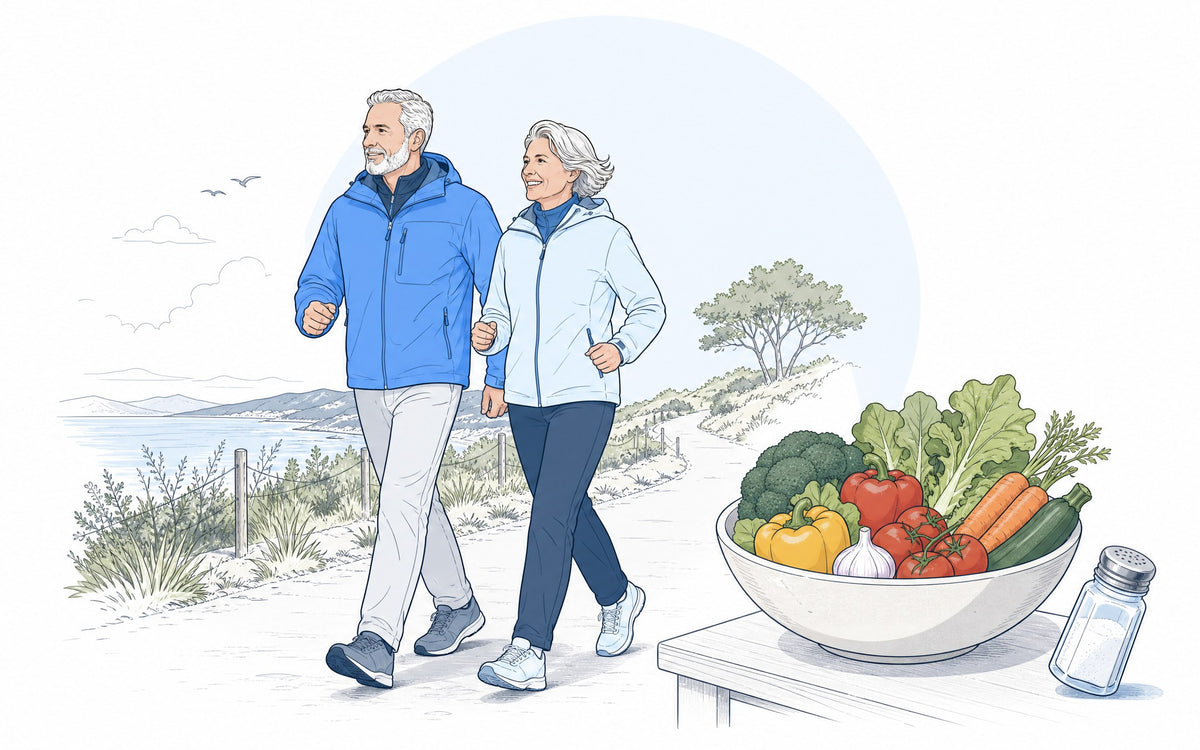
- How much exercise do you need?
- What do we know about nutrients?
- What should you discuss with your doctor?
- Raised coronary calcium score and exercise: in brief
- Frequently asked questions
- Sources
The key points
- A raised coronary calcium score is a finding to take seriously. But it’s no reason to stop exercising without talking to your doctor first. In a study of 21,758 men, very active men with a high calcium score had no higher risk of death than men who did little exercise1.
- People who do a great deal of endurance exercise over many years more often have calcium in their coronary arteries2. In women, an analysis of nine studies didn’t find this3.
- Two measurements are worth a close look: your blood pressure measured over 24 hours, and the inflammation marker hsCRP4,5.
- Fitness matters either way: in large studies, fitter people live longer6. Even a few minutes of vigorous activity in everyday life are linked with a lower risk of death7.
Many people find out at a health check: the CT scan shows calcium in the coronary arteries. If you’ve exercised a lot for years, that can be particularly unsettling. Research paints a more detailed picture than the number alone suggests.
39%
of the endurance athletes studied had undiagnosed high blood pressure on 24-hour monitoring4.
5 times
as great a risk of death with low fitness as with the highest fitness level6.
What does the coronary calcium score (Agatston score) measure?
The coronary calcium score, also called the calcium score, CAC score or Agatston score, is measured with a computed tomography (CT) scan of the heart8. It shows how much calcified plaque can be seen in the coronary arteries. Studies often use four bands: 0, 1 to 99, 100 to 399, and 400 or more9.
In studies, the higher the score, the more common cardiovascular events generally were9. But the calcium score is only part of the picture. How your own score should be read also depends on your age, sex, blood pressure, blood test results and fitness, and that’s something to go through with your doctor.
Agatston score table: what the values mean
The MESA study shows how much a score can tell you. It followed 6,814 adults aged 45 to 84 with no known cardiovascular disease for eleven years on average10. The table shows how many of them had a heart attack, a stroke, a resuscitated cardiac arrest, or cardiac death within ten years10.
MESA study, 6,814 participants aged 45 to 84 with no known cardiovascular disease. Source: Budoff et al. (2018), European Heart Journal10.
In every age group and in both sexes, the proportion rose from one band to the next10. Where the bands are drawn differs from study to study. The figures come from the USA and describe groups, not individual people.
Why do some athletes have more calcium?
In a study of 284 active men aged around 55, researchers compared how much exercise they’d done over their whole lives with their CT scans2. In the group that had done the most exercise, 68% had calcium in their coronary arteries; in the group that had done the least, 43%2.
A larger study of 21,758 men found the same link, though a weaker one. Very active men were somewhat more likely to have a calcium score of 100 or more; the relative risk was 1.111.
Why this happens hasn’t been conclusively established4. One possible clue is blood pressure, which we come to below.
Does more calcium in active people also mean more risk?
The researchers behind the large study followed the men for just over ten years on average1. Among men with a calcium score of 100 or more, the very active had no higher risk of death than those who did little exercise1. In men who did little exercise, by contrast, a score of 100 or more was linked with about twice the risk of dying from cardiovascular disease1.
A second analysis of 8,425 men showed a similar pattern: at every calcium level, fitter men had cardiovascular events less often9. With every 1 MET increase in fitness, the risk was 11% lower9.
Both are observational studies in men. They show associations, not proof of cause and effect. How to interpret results like these is explained in our article on understanding the evidence.
Is all calcium the same?
The calcium score combines two things in one number: how much calcium there is and how dense it is8. A study of 3,398 men and women aged 45 to 84 looked at the two separately8. A larger volume of calcium was linked with more cardiovascular events, whereas denser calcium at the same volume was linked with fewer8.
An observation in athletes fits with this. The most active group more often had only calcified plaques (38% versus 16%) and less often mixed plaques (48% versus 69%)2. The authors interpret this as a more favourable composition2.
The evidence isn’t entirely consistent, though. In a study of 191 lifelong endurance athletes and 176 healthy non-athletes, all of them men, the athletes were also more likely to have non-calcified plaques11. Here the researchers found no more favourable composition11. The question remains open.
Does this also apply to women?
Most of the studies mentioned looked only at men1,2,11. A review from 2025 analysed nine studies with 61,150 participants in total, looking at men and women separately3. Men who did a great deal of exercise had higher calcium scores than non-athletes. In female athletes, no such difference was found3.
For women, another blood test is well studied: high-sensitivity CRP (hsCRP), a marker of inflammation in the blood. A study followed 27,939 initially healthy women, with an average age of just under 55, for 30 years5. Women in the top fifth of hsCRP levels had a 70% higher risk of a first major cardiovascular event than women in the bottom fifth5. For LDL cholesterol, this difference was 36%5.
What role does blood pressure play?
A 2026 study looked at 198 older male endurance athletes with no known high blood pressure4. They wore a monitor for 24 hours. In 39% of them, blood pressure was too high over that period, and in 47% it rose excessively during exertion4.
Both were linked with the CT findings. With undetected high blood pressure, the odds of a calcium score of 100 or more were about 2.6 times as high4. With an excessive rise during exertion, the odds of a coronary artery being narrowed by more than 50% were about 4.7 times as high4.
In practice, this means a normal reading at your doctor’s surgery doesn’t reliably rule out high blood pressure. If your calcium score is raised, ask your doctor about 24-hour blood pressure monitoring. What you can do yourself is covered in our article on lowering high blood pressure.
Worth knowing: Exercise itself is a well-studied way of bringing blood pressure down. In an analysis of 270 studies with 15,827 participants, endurance training lowered resting blood pressure by an average of 4.5/2.5 mmHg, and isometric training such as wall sits by 8.2/4.0 mmHg12.
How does the heart build its own bypasses?
Between the coronary arteries there are small connecting vessels called collaterals. They work like natural bypasses and can supply blood when a vessel narrows13.
In a randomised controlled trial, 60 patients with narrowed coronary arteries were divided into three groups: intensive training, moderate training or no training13. The training lasted four weeks, at about ten hours a week13. Blood flow through the collaterals rose by about 40% in both training groups and stayed the same in the control group13. Moderate training did just as well as intensive training13.
An analysis of 12 studies with 6,529 patients shows why this can matter: patients with well-developed collaterals had a 36% lower risk of death14. These data come from people with known heart disease, and for them, training on this scale should be done under medical supervision.
How much exercise do you need?
The clearest data concern fitness. In a study of 122,007 patients with an average age of 53, fitness was measured on a treadmill and deaths were tracked for just over eight years6. The fitter the participants, the lower their risk of death, with no apparent upper limit6. In the group with the lowest fitness, the risk was about five times as high as in the fittest group6.
What stands out: even the difference between below-average and above-average fitness was as large as the risk linked to smoking6. So the biggest gain comes from moving out of the lowest-fitness group.
You don’t have to run a marathon for this. In a study of 25,241 adults aged around 62 who didn’t do any sport, activity trackers recorded short, strenuous bursts of one to two minutes in everyday life7. Those who managed three such bursts a day had a 38 to 40% lower risk of death than people with none7. Climbing the stairs briskly would be one example.
Steps count too. An analysis of 15 studies with 47,471 adults found that in people aged 60 and over, the risk of death fell as daily steps rose, up to about 6,000 to 8,000 steps a day15. In younger adults, this range was 8,000 to 10,000 steps15.
What do we know about nutrients?
There is one authorised health claim relating to the heart. EPA and DHA contribute to the normal function of the heart. The beneficial effect is obtained with a daily intake of 250 mg of EPA and DHA16. Our Omega 3 meets this condition at the recommended daily amount. The claim is about heart function, not about the calcium score.
A study on vitamin K2 was published in 2026: 167 patients with heart symptoms and a calcium score between 50 and 400 took vitamin K2 (MK-7) or a placebo every day for two years17. With the placebo, the average calcium score rose from 145 to 214; with vitamin K2, from 135 to 18417.
So the rise was smaller with vitamin K2. The authors themselves stress that what this means for health is still an open question17. Our products weren’t tested in this study.
We offer vitamin K2 together with vitamin D3 in our Liposomal Vitamin D3+K2 (Capsules). You can read more in our article on the research into vitamin D3 and K2 together. If you take any medicines, check with your doctor before starting a food supplement. Do not exceed the recommended daily amount.
What should you discuss with your doctor?
A raised calcium score is a good reason for a thorough conversation with your doctor. Don’t stop exercising without talking to your doctor, but don’t start very intensive training without checking first, either.
- Have your blood pressure measured over 24 hours and during exertion4.
- Have your hsCRP (an inflammation marker) and blood fats (lipids) checked5.
- Have your fitness assessed, for example with an exercise stress test6.
- Take any prescribed medicines as agreed with your doctor.
Chest pain, shortness of breath or a feeling of tightness during exertion are warning signs. If you notice any of them, get medical help immediately.
Raised coronary calcium score and exercise: in brief
A raised calcium score is a reason to talk to your doctor, but no reason to give up training without speaking to your doctor. In a large observational study, very active men with a calcium score of 100 or more had no higher risk of death than men who did little exercise1. Have your blood pressure, blood test results and fitness checked. EPA and DHA contribute to the normal function of the heart. The beneficial effect is obtained with a daily intake of 250 mg16, which our Omega 3 provides at the recommended daily amount.
Frequently asked questions
What is a normal coronary calcium score?
A score of 0 means no calcium can be seen on the CT scan. Above that, studies often use the bands 1 to 99, 100 to 399, and 400 or more9. What counts as normal for you depends on your age and sex, and your doctor will assess it.
Can a calcium score go down again?
In the vitamin K2 study, the calcium score rose over two years in both groups17. That’s why the overall picture matters more than the number itself: blood pressure, blood test results and fitness.
Is a lot of endurance exercise bad for the heart?
Current evidence suggests there’s little reason to think so. In a large study, very active men were somewhat more likely to have calcium, but no higher risk of death1. In women, an analysis of nine studies found no link between high levels of exercise and coronary calcium3.
Sources
- DeFina LF, Radford NB, Barlow CE, et al. (2019). Association of All-Cause and Cardiovascular Mortality With High Levels of Physical Activity and Concurrent Coronary Artery Calcification. JAMA Cardiology 4(2):174-181. DOI
- Aengevaeren VL, Mosterd A, Braber TL, et al. (2017). Relationship Between Lifelong Exercise Volume and Coronary Atherosclerosis in Athletes. Circulation 136(2):138-148. DOI
- Abdelaziz A, Elshahat A, Gadelmawla AF, et al. (2025). Sex Differences in the Impact of Exercise Volume on Subclinical Coronary Atherosclerosis: A Meta-Analysis. JACC: Advances 4(6 Pt 1):101786. DOI
- O'Driscoll J, Parry-Williams G, Moser J, et al. (2026). Resting and exercise-induced occult hypertension and coronary atherosclerosis in male masters endurance athletes. British Journal of Sports Medicine 60(16):1227-1237. DOI
- Ridker PM, Moorthy MV, Cook NR, Rifai N, Lee IM, Buring JE (2024). Inflammation, Cholesterol, Lipoprotein(a), and 30-Year Cardiovascular Outcomes in Women. New England Journal of Medicine 391(22):2087-2097. DOI
- Mandsager K, Harb S, Cremer P, Phelan D, Nissen SE, Jaber W (2018). Association of Cardiorespiratory Fitness With Long-term Mortality Among Adults Undergoing Exercise Treadmill Testing. JAMA Network Open 1(6):e183605. DOI
- Stamatakis E, Ahmadi MN, Gill JMR, et al. (2022). Association of wearable device-measured vigorous intermittent lifestyle physical activity with mortality. Nature Medicine 28(12):2521-2529. DOI
- Criqui MH, Denenberg JO, Ix JH, et al. (2014). Calcium density of coronary artery plaque and risk of incident cardiovascular events. JAMA 311(3):271-8. DOI
- Radford NB, DeFina LF, Leonard D, et al. (2018). Cardiorespiratory Fitness, Coronary Artery Calcium, and Cardiovascular Disease Events in a Cohort of Generally Healthy Middle-Age Men: Results From the Cooper Center Longitudinal Study. Circulation 137(18):1888-1895. DOI
- Budoff MJ, Young R, Burke G, et al. (2018). Ten-year association of coronary artery calcium with atherosclerotic cardiovascular disease (ASCVD) events: the multi-ethnic study of atherosclerosis (MESA). European Heart Journal 39(25):2401-2408. DOI
- De Bosscher R, Dausin C, Claus P, et al. (2023). Lifelong endurance exercise and its relation with coronary atherosclerosis. European Heart Journal 44(26):2388-2399. DOI
- Edwards JJ, Deenmamode AHP, Griffiths M, et al. (2023). Exercise training and resting blood pressure: a large-scale pairwise and network meta-analysis of randomised controlled trials. British Journal of Sports Medicine 57(20):1317-1326. DOI
- Möbius-Winkler S, Uhlemann M, Adams V, et al. (2016). Coronary Collateral Growth Induced by Physical Exercise: Results of the Impact of Intensive Exercise Training on Coronary Collateral Circulation in Patients With Stable Coronary Artery Disease (EXCITE) Trial. Circulation 133(15):1438-48. DOI
- Meier P, Hemingway H, Lansky AJ, Knapp G, Pitt B, Seiler C (2012). The impact of the coronary collateral circulation on mortality: a meta-analysis. European Heart Journal 33(5):614-21. DOI
- Paluch AE, Bajpai S, Bassett DR, et al. (2022). Daily steps and all-cause mortality: a meta-analysis of 15 international cohorts. The Lancet Public Health 7(3):e219-e228. DOI
- Europäische Kommission (2012). Verordnung (EU) Nr. 432/2012 zur Festlegung einer Liste zulässiger anderer gesundheitsbezogener Angaben über Lebensmittel (konsolidierte Fassung vom 17.05.2021). Link
- Vossen LM, de Leeuw PW, Schurgers LJ, et al. (2026). Two Years of Menaquinone-7 Supplementation and Coronary Artery Calcification: A Randomized Clinical Trial. JAMA Cardiology 11(8):719-726. DOI
This article is for general information only and should not replace medical advice. Food supplements are not a substitute for a balanced and varied diet and a healthy lifestyle.
Written by
Melinava Editorial Team