


Your cart is empty

In this article
The key points
- Collagen studies on skin mostly measure elasticity, hydration (moisture) and wrinkles. In two reviews (meta-analyses), collagen hydrolysate did better than placebo on these measures on average1,2.
- ‘The Kiel study’ actually refers to two studies from 2014, with 69 and 114 women, carried out with the involvement of the dermatology clinic at Kiel University in Germany. Both tested specific collagen peptides, and the second used a branded, trademarked ingredient3,4.
- There’s no authorised health claim for collagen. There is one for vitamin C: ‘Vitamin C contributes to normal collagen formation for the normal function of skin’.
What is the Kiel study?
The name ‘Kiel study’ covers two studies published in 2014. The first author worked at the dermatology clinic of Kiel University, and the other authors came from a collagen research institute in Kiel and from an institute that specialises in skin measurements3,4. Both studies were randomised and double-blind: the women took either collagen or a placebo once daily for eight weeks3,4.
The first study: elasticity and hydration
In the first study, 69 women aged 35 to 55 took 2.5 g or 5 g of a collagen hydrolysate or a placebo every day, with 23 women in each group3. The hydrolysate consisted of specific collagen peptides, that is, collagen broken down into small fragments. Skin elasticity, hydration, water loss and roughness were measured with instruments3.
After eight weeks, skin elasticity was statistically significantly higher in both collagen groups than in the placebo group3. In the older women, it was still higher four weeks after they stopped taking the collagen. For hydration and water loss, only a subgroup showed a favourable trend, and it wasn’t statistically significant3.
The second study: wrinkles around the eyes
In the second study, 114 women aged 45 to 65 took 2.5 g of specific bioactive collagen peptides or a placebo every day, with 57 women in each group4. These peptides are a registered branded ingredient. The researchers measured the volume of the wrinkles around the eyes and, in a subgroup, also components of the connective tissue in the skin4.
Compared with the placebo group, the volume of the eye wrinkles fell by 20% after eight weeks, and the difference could still be detected four weeks after the women had stopped taking them4. In the subgroup, there was 65% more procollagen type I and 18% more elastin than with placebo. The difference in fibrillin wasn’t statistically significant4.
Good to know The Kiel studies ran for eight weeks and took instrument measurements of the skin3,4. Their results hold for the peptides tested, in the amount tested, and can’t simply be applied to other collagen products.
What do the reviews and meta-analyses show?
A review from 2021 analysed 19 randomised, double-blind studies with a total of 1,125 participants aged 20 to 70, 95% of them women1. When the results were pooled, collagen hydrolysate did better than placebo for hydration, elasticity and wrinkles1.
19 studies
With 1,125 participants, pooled in one review of collagen and skin1
20%
Lower eye wrinkle volume than with placebo after eight weeks in the second Kiel study4
A second review from 2023, covering 26 studies and 1,721 participants, reached a similar result for hydration and elasticity2. For hydration, the results depended on the source of the collagen and how long it was taken. The authors also found several sources of bias in the studies, though, and believe larger studies are needed2.
How to put the results in context
Each study tested specific collagen peptides in a specific amount, so its results apply mainly to that exact formulation. To learn how to judge studies for yourself, read our article on understanding the evidence.
Which claim is authorised for the skin?
There’s no authorised health claim for collagen in the UK or the EU. The studies can be described, but they don’t justify any promise of an effect. By contrast, there is an authorised health claim for vitamin C: ‘Vitamin C contributes to normal collagen formation for the normal function of skin’.
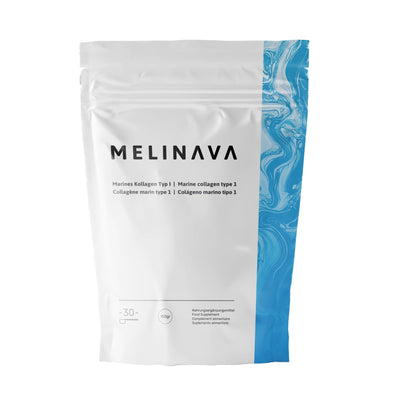
What sets vitamin C in a serum apart from vitamin C in a capsule is explained in our article on vitamin C for the skin. Melinava offers Marine Collagen, and like all our products, it’s manufactured to European pharmaceutical quality.
Frequently asked questions about collagen studies
What did the Kiel University collagen study find?
In the first study, skin elasticity was higher than with placebo after eight weeks3. In the second, eye wrinkle volume fell by 20% compared with placebo4. Each study tested specific collagen peptides in women.
Are there any studies on collagen and wrinkles?
Yes. Besides the second Kiel study, several reviews have looked at wrinkles as an outcome. When the results were pooled, collagen hydrolysate did better than placebo1.
How well does collagen work, according to the research?
That hasn’t been conclusively settled yet. On average, reviews found better skin measurements than with placebo1,2. There’s more in our article on whether taking collagen is worth it.
Sources
- de Miranda RB, Weimer P, Rossi RC (2021). Effects of hydrolyzed collagen supplementation on skin aging: a systematic review and meta-analysis. International Journal of Dermatology 60(12):1449-1461. DOI
- Pu SY, Huang YL, Pu CM, et al. (2023). Effects of Oral Collagen for Skin Anti-Aging: A Systematic Review and Meta-Analysis. Nutrients 15(9):2080. DOI
- Proksch E, Segger D, Degwert J, Schunck M, Zague V, Oesser S (2014). Oral supplementation of specific collagen peptides has beneficial effects on human skin physiology: a double-blind, placebo-controlled study. Skin Pharmacology and Physiology 27(1):47-55. DOI
- Proksch E, Schunck M, Zague V, Segger D, Degwert J, Oesser S (2014). Oral intake of specific bioactive collagen peptides reduces skin wrinkles and increases dermal matrix synthesis. Skin Pharmacology and Physiology 27(3):113-119. DOI
This article is for general information only and should not replace medical advice. Food supplements are not a substitute for a balanced and varied diet and a healthy lifestyle.
Written by
Melinava Editorial Team