
Your cart is empty

In this article
At a glance
- What is coenzyme Q10 for? In the body, Q10 is involved in energy production in the mitochondria, the powerhouses of your cells. As you get older, your body makes less of it, which is why people from midlife onwards in particular are interested in Q10 as a food supplement.
- There is no authorised health claim for coenzyme Q10 in the UK or the EU. Studies mainly measure how much Q10 reaches the blood after you take it.
- Ubiquinone and ubiquinol are two forms of the same substance. In the blood, Q10 is mostly present as ubiquinol, even if you take ubiquinone.
- Q10 is fat-soluble. In one study, blood levels were higher with a liposomal form than with conventional Q10.
What is coenzyme Q10?
Coenzyme Q10 is a substance your body makes itself. It sits in the inner membrane of the mitochondria, the powerhouses of your cells, and links several metabolic pathways to energy production1. Its other name, ubiquinone, comes from the Latin ‘ubique’, meaning ‘everywhere’.
As we get older, the Q10 content of some tissues falls1, and the body makes less of it2. That’s why many people from midlife onwards in particular take an interest in Q10.
What does coenzyme Q10 do, and what do people take it for?
There is no authorised health claim for coenzyme Q10 in the UK or the EU. So this article doesn’t describe what Q10 is supposed to do, but what studies have measured. Mostly, that’s the amount of Q10 in the blood, because it shows how well the body absorbs a particular form.
You also get some Q10 from food. Meat, fish, nuts and some oils contain the most, while dairy products, vegetables, fruit and cereals contain markedly less3. On average, this adds up to only 3 to 6 mg a day, about half of it in the reduced form3.
Ubiquinone or ubiquinol: what’s the difference?
Q10 comes in two forms: ubiquinone is the oxidised form, ubiquinol the reduced one. In the blood, about 95% of Q10 is present as ubiquinol4, and ubiquinone that you take also turns up there mostly as ubiquinol2.
A question people often ask is whether ubiquinol gets more Q10 into the blood. A study in 150 healthy adults with an average age of 52 compared ubiquinone, ubiquinol and a placebo, among other things, over eight weeks. Both forms raised blood Q10 more than the placebo, and there was no difference between them5. In 21 healthy people aged 65 to 74, a single dose also showed no clear difference2.
So when it comes to choosing a form, both get Q10 into the blood.
3 to 6 mg
of Q10 a day is what people take in from food on average3.
95%
of Q10 in the blood is present as ubiquinol4.
What is liposomal Q10?
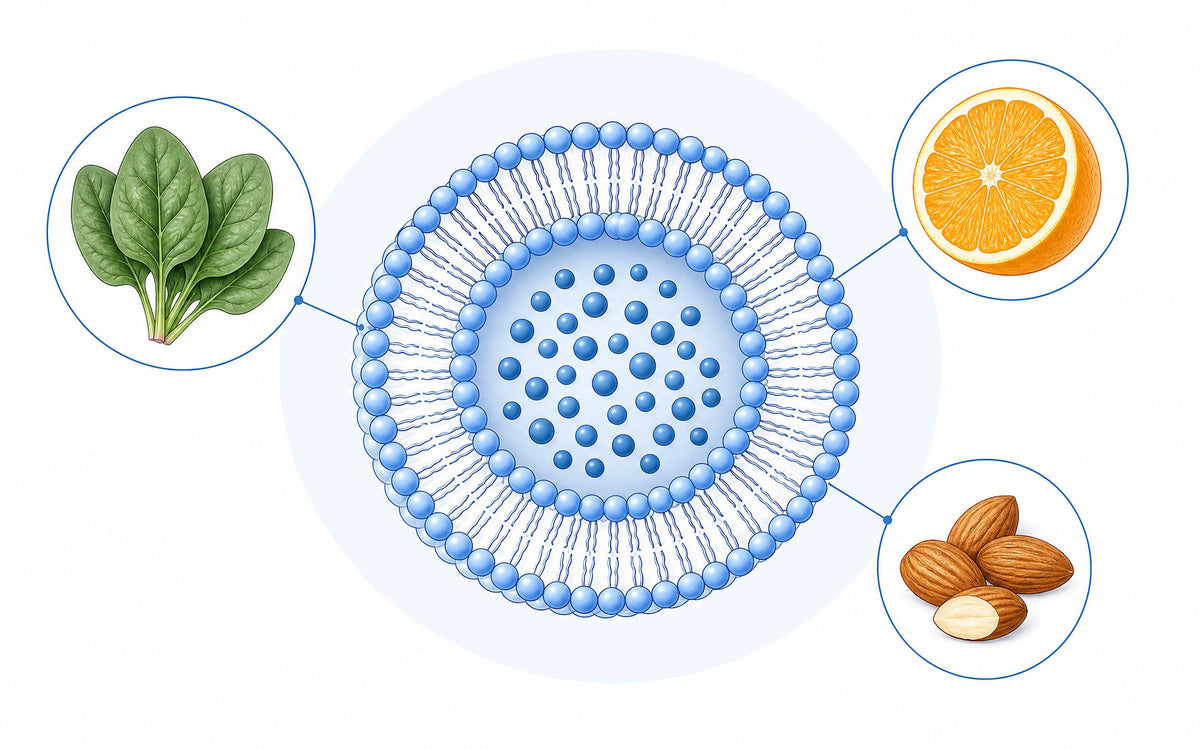
Q10 is fat-soluble and a comparatively large molecule, so the body absorbs it only to a limited extent, and a meal containing fat can increase absorption6. In liposomal Q10, the substance is enclosed in tiny vesicles made of phospholipids. You can read how these vesicles are built in our article ‘What are liposomes?’.
One study set out to find whether a liposomal form improves absorption even without a fatty meal. The 18 healthy adults taking part each received a placebo, 100 mg of conventional Q10 and 100 mg of liposomal Q10, once each, one after the other. With the liposomal form, the peak blood level was 31% higher, and 23% higher calculated over 24 hours6. Our article on bioavailability explains how to read figures like these.
Good to know: Some of the absorption studies are small, and some were carried out or funded by manufacturers2,4,6. What they measured were blood levels. They can’t tell us what this means for your wellbeing.
When and how should you take Q10?
Because Q10 is fat-soluble, a meal with some fat is a good choice: fat can increase absorption6. This applies to ubiquinone and ubiquinol alike. The studies don’t specify a particular time of day. There’s more in our article ‘On an empty stomach or with food?’.
Do not exceed the recommended daily amount. If you take any medicines, check with your doctor first.
What does this mean for you?
Coenzyme Q10 is a substance your body makes itself, and its production declines with age2. In studies, ubiquinone and ubiquinol both raise blood Q105, and in one study a liposomal form reached higher levels than conventional Q106. For our liposomal products, we use phospholipids from European sunflowers.
Frequently asked questions about coenzyme Q10
What is coenzyme Q10 taken for?
Many people become interested in Q10 as the years go by, because the body makes less of it with age2. There is no authorised health claim for this in the UK or the EU. Studies mainly show that taking it raises the level of Q10 in the blood5.
Coenzyme Q10 as ubiquinol: when should you take it?
Like ubiquinone, ubiquinol is fat-soluble, so a meal with some fat is a good time to take it6. Do not exceed the recommended daily amount.
What is known about the effects of liposomal Q10?
Health claims about the effects of Q10 are not authorised in the UK or the EU. A study of 18 adults measured higher blood Q10 with a liposomal form than with conventional Q106. How this affects wellbeing was not examined in that study.
Sources
- Díaz-Casado ME, Quiles JL, Barriocanal-Casado E, et al. (2019). The Paradox of Coenzyme Q10 in Aging. Nutrients 11(9):2221. DOI
- Pravst I, Rodríguez Aguilera JC, Cortes Rodriguez AB, et al. (2020). Comparative Bioavailability of Different Coenzyme Q10 Formulations in Healthy Elderly Individuals. Nutrients 12(3):784. DOI
- Pravst I, Žmitek K, Žmitek J (2010). Coenzyme Q10 contents in foods and fortification strategies. Critical Reviews in Food Science and Nutrition 50(4):269-280. DOI
- Bhagavan HN, Chopra RK (2007). Plasma coenzyme Q10 response to oral ingestion of coenzyme Q10 formulations. Mitochondrion 7(Suppl):S78-S88. DOI
- D'Adamo CR, Leary M, Mote C, et al. (2026). A Randomized, Double-Blind, Placebo-Controlled Trial Comparing the Effects of Commercially Available Ubiquinone, Ubiquinol, and Geranylgeraniol Dietary Supplements on Plasma CoQ10 Concentrations. Journal of Nutrition and Metabolism 2026(1):5589963. DOI
- Jäger R, Purpura M, Godavarthi A, et al. (2025). Impact of liposomal delivery on coenzyme Q10 absorption: a double-blind, placebo-controlled, randomized trial. Frontiers in Nutrition 12:1605033. DOI
This article is for general information only and should not replace medical advice. Food supplements are not a substitute for a balanced and varied diet and a healthy lifestyle.
Written by
Melinava Editorial Team