
Your cart is empty

In this article
- Key points
- What is GABA?
- Does GABA taken as a supplement reach the brain?
- What have studies on GABA measured?
- L-theanine effects: what is L-theanine?
- L-theanine with coffee: what do studies show?
- What’s known about GABA with L-theanine?
- What does ‘liposomal’ mean for GABA and L-theanine?
- What should you bear in mind when taking them?
- Frequently asked questions about L-theanine and GABA
- Sources
Key points at a glance
- Liposomal GABA with L-theanine contains two substances: GABA is a chemical messenger (neurotransmitter) in the nervous system, and L-theanine is an amino acid found in tea leaves. In liposomal form, both are enclosed in tiny vesicles made of phospholipids.
- Neither substance has an authorised health claim in the UK or the EU.
- Whether GABA taken as a supplement crosses the blood-brain barrier isn’t settled. L-theanine, researchers know, can cross the barrier.
- Human studies have mainly looked at stress, sleep and attention, using questionnaires and tests. Many of these studies were small.
What is GABA?
GABA stands for gamma-aminobutyric acid. It’s the main inhibitory chemical messenger in the brain, meaning one that nerve cells use to dampen signals1. Unlike many other amino acids, GABA isn’t used as a building block of proteins2.
GABA occurs naturally in some foods. Studies have used both GABA from foods and GABA made by fermentation2. There’s no authorised health claim for GABA as a food supplement in the UK or the EU.
Does GABA taken as a supplement reach the brain?
It’s a question many people ask, and it hasn’t been settled. Between the blood and the brain lies the blood-brain barrier, which only lets certain substances through. For a long time it was assumed that GABA can’t cross it, but the studies on this contradict each other and use very different methods1.
If GABA from supplements does have effects, researchers think these could come about either via the barrier or indirectly via the gut’s own nervous system1. To settle the question, studies would need to measure GABA levels directly in the human brain, for example with magnetic resonance spectroscopy1.
What have studies on GABA measured?
A systematic review found 14 human studies that compared GABA with a placebo and recorded stress, sleep and related measures2. The results were mixed: for stress the authors saw limited evidence, and for sleep very limited evidence2. An earlier review pointed out that most of the positive findings came from researchers with possible conflicts of interest1.
L-theanine effects: what is L-theanine?
L-theanine is an amino acid found in abundance in tea leaves, and it isn’t used to build protein3. It’s well absorbed from the gut and can cross the blood-brain barrier3. So the picture here is clearer than with GABA. For L-theanine, too, there’s no authorised health claim in the UK or the EU.
In one study of 30 healthy adults with an average age of 48, participants took 200 mg of L-theanine a day for four weeks and, in another phase, a placebo4. While taking L-theanine, their questionnaire scores for mood, tension and sleep quality were better than at the start. Some individual sleep measures, such as the time it took to fall asleep, were also better than with the placebo4. Two of the authors are employed by the company that supplied the tablets4.
L-theanine with coffee: what do studies show?
Tea naturally contains both caffeine and L-theanine. An analysis of 11 placebo-controlled studies on tea components found that in the first two hours after taking them, scores for alertness and for accuracy when switching attention were higher with the combination than with a placebo5.
In another study, 27 participants were given 50 mg of caffeine with or without 100 mg of L-theanine, or a placebo, with one week between each session. With the combination, after 60 minutes they completed an attention-switching task faster and more accurately than with the placebo6. How long to leave between coffee and other supplements is covered in our article on coffee and food supplements.
What’s known about GABA with L-theanine?
On the combination of the two substances, we found only one small human study. In it, 19 adults whose sleep scores were poor at the start took 700 mg of GABA and 200 mg of L-theanine a day for four weeks7. Over this time, their score on a sleep-quality questionnaire fell from an average of 9.4 to 6.3 points, with lower scores being better7. As there was no placebo group, it’s impossible to say how much of this was down to the substances.
Good to know: The studies on L-theanine and on the combination described here were small and lasted four weeks at most4,6,7.
What does ‘liposomal’ mean for GABA and L-theanine?
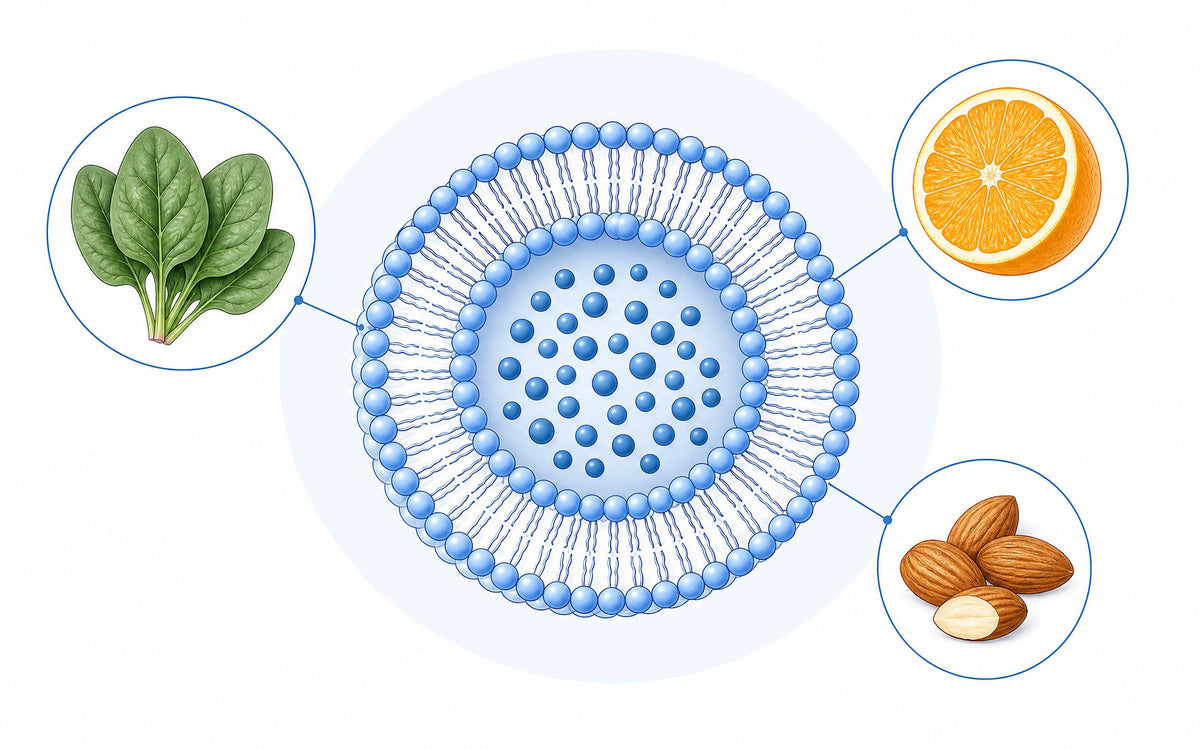
In liposomal preparations, the substances are enclosed in tiny vesicles made of phospholipids, known as liposomes. GABA and L-theanine are water-soluble and fit into the watery core of these vesicles. You can read how liposomes are built in our article on what liposomes are.
In our research, we found no human studies comparing liposomal with conventional GABA or L-theanine.
What should you bear in mind when taking them?
For L-theanine, toxicology studies describe a good safety profile3. Don’t take more than the recommended daily amount, and if you take any medicines, check with your doctor first. For our liposomal products, we use phospholipids from sunflowers grown in Europe.
Frequently asked questions about L-theanine and GABA
What is GABA taken for?
No health claims for GABA are authorised in the UK or the EU. Studies have mainly recorded stress and sleep using questionnaires and measurements, with mixed results2.
Taking GABA: does it cross the blood-brain barrier?
That hasn’t been settled. Studies contradict each other, and direct measurements in the human brain are still lacking1. L-theanine, on the other hand, can cross the barrier3.
Can I take L-theanine with coffee?
The combination has been looked at in several studies, as both substances occur naturally in tea. In the first two hours, alertness and attention were higher with caffeine and L-theanine than with a placebo5. If you’re sensitive to caffeine, keep an eye on how much coffee you drink.
Sources
- Boonstra E, de Kleijn R, Colzato LS, et al. (2015). Neurotransmitters as food supplements: the effects of GABA on brain and behavior. Frontiers in Psychology 6:1520. DOI
- Hepsomali P, Groeger JA, Nishihira J, Scholey A (2020). Effects of Oral Gamma-Aminobutyric Acid (GABA) Administration on Stress and Sleep in Humans: A Systematic Review. Frontiers in Neuroscience 14:923. DOI
- Dashwood R, Visioli F (2025). l-theanine: From tea leaf to trending supplement. Does the science match the hype for brain health and relaxation? Nutrition Research 134:39-48. DOI
- Hidese S, Ogawa S, Ota M, et al. (2019). Effects of L-Theanine Administration on Stress-Related Symptoms and Cognitive Functions in Healthy Adults: A Randomized Controlled Trial. Nutrients 11(10):2362. DOI
- Camfield DA, Stough C, Farrimond J, Scholey AB (2014). Acute effects of tea constituents L-theanine, caffeine, and epigallocatechin gallate on cognitive function and mood: a systematic review and meta-analysis. Nutrition Reviews 72(8):507-522. DOI
- Owen GN, Parnell H, De Bruin EA, Rycroft JA (2008). The combined effects of L-theanine and caffeine on cognitive performance and mood. Nutritional Neuroscience 11(4):193-198. DOI
- Konno H, Naganuma K, Kamada Y (2026). Effects of combined GABA and L-theanine supplementation on sleep quality: an exploratory study. European Review for Medical and Pharmacological Sciences 30(1):37-45. DOI
This article is for general information only and should not replace medical advice. Food supplements are not a substitute for a balanced and varied diet and a healthy lifestyle.
Written by
Melinava Editorial Team