

Your cart is empty

In this article
At a glance
- Berberine patches are marketed as a convenient alternative to taking berberine by mouth. We found no study in humans showing that berberine from one of these patches reaches the blood.
- Your skin is a strong barrier. Conventional medicated patches mainly work with small, fat-soluble active ingredients in small amounts.
- Pure berberine dissolves readily in water. In laboratory experiments, it penetrates the skin poorly.
- Our verdict: not proven. So far, no study in humans has shown that a patch delivers meaningful amounts of berberine into the body.
What’s behind the trend
On social media and in online shops, you’ll come across patches that are supposed to release berberine and other plant compounds through the skin. The idea is simple: stick it on instead of swallowing it. A scientific paper from 2026 examined 24 of these patch products. On average, they contained seven ingredients, and berberine was among the most common1.
None of the products had a published certificate of analysis documenting what they contain. In the authors’ assessment, many sellers advertised their patches in a misleading way1. That leaves buyers with hardly any way of checking how much berberine a patch contains, or how much of it is released.
It’s easy to see the appeal: a patch releases a substance over several hours, and you can’t forget a dose. Whether it works, though, depends heavily on the properties of the substance, and that’s exactly where berberine runs into difficulty.
What is berberine?
Berberine is a natural plant compound belonging to the group known as alkaloids2. No health claim has been authorised for berberine in the UK or the EU3, so we won’t be naming any effects here. We’re looking at one question only: does berberine from a patch get into the body at all?
The term bioavailability describes how much of a substance reaches the blood after it has been taken or applied. With a patch, the substance first has to get through the skin.
Can berberine get through the skin?
Your skin protects your body, and its outermost layer, the stratum corneum (a layer of dead skin cells), is the real barrier4. Conventional medicated patches mainly deliver small, fat-soluble active ingredients in low doses through this layer. Other substances need extra help, such as chemical penetration enhancers or microneedles4.
Pure berberine doesn’t fit this pattern well. It dissolves readily in water and penetrates the skin poorly, which makes applying it to the skin difficult5. Researchers are therefore developing special compounds that make berberine more fat-soluble. In an experiment on rat skin, these penetrated better than pure berberine5.
What the research shows
In a study on rats, berberine was detected in the blood after specially developed creams had been applied. The study comes from a company that has filed a patent for these formulations2. Whether the results can be applied to humans, and to the patches on sale, is an open question.
In the PubMed database, we found no studies in humans that measured whether berberine from a patch reaches the blood (search carried out in October 2026). The research that does exist comes from the laboratory or from animal experiments, and it uses creams or gels rather than simple patches2,5.
24
Patch products containing plant compounds were examined in a scientific paper. Berberine was among the most common ingredients1.
0
Certificates of analysis were published for these products1.
Is a patch a food supplement?
Under EU law, food supplements are foods sold in dose form, for example capsules, tablets, powder sachets or dropper bottles, intended to be taken in small measured amounts6. A patch isn’t one of the forms named there.
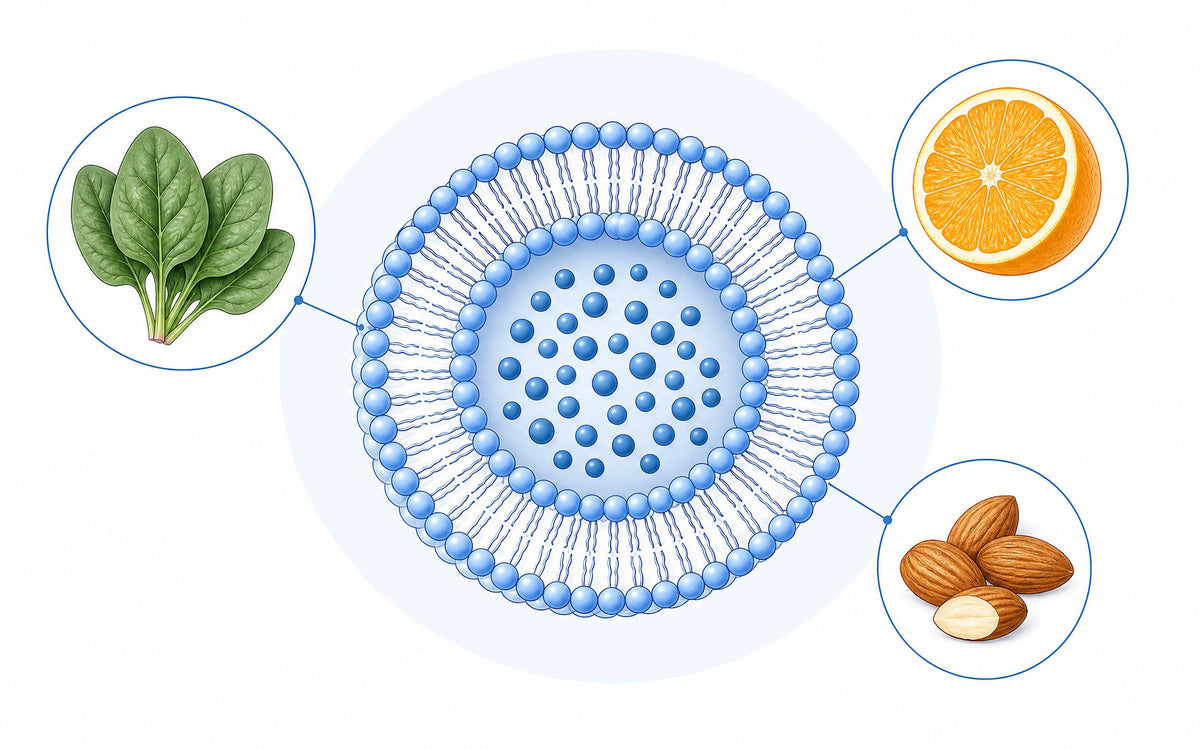
As a food supplement, berberine is therefore available as capsules or in liquid form. If you’re wondering what a liposomal form is, you’ll find it explained in our article on what liposomal means.
Our verdict on berberine patches: not proven
It isn’t proven that a berberine patch delivers meaningful amounts of berberine into the body. We found no study in humans on this, and the properties of pure berberine, if anything, point against good absorption through the skin4,5. For our liposomal products, we use phospholipids from European sunflowers.
Frequently asked questions about berberine patches
What is a berberine patch?
A patch that’s supposed to release berberine through the skin, often together with other plant compounds1. Whether berberine reaches the blood in meaningful amounts hasn’t been investigated in humans.
What is berberine taken for?
No health claim has been authorised for berberine in the UK or the EU3, so we don’t name any effects here. If you take any medicines, speak to your doctor before taking berberine. Do not exceed the recommended daily amount.
Can berberine be applied to the skin?
Researchers are developing creams, gels and special compounds to help berberine penetrate the skin better, so far in the laboratory and on rats2,5. You can read how liposomes are used in creams and gels in our article on liposomes in creams, gels and sprays.
Sources
- White CM, Tai Z, Nuzi K (2026). Transdermal "Natural GLP-1" Dietary Supplements Violate Law and Place Patients at Risk. Annals of Pharmacotherapy 60(8):813-816. DOI
- Buchanan B, Meng Q, Poulin MM, et al. (2018). Comparative pharmacokinetics and safety assessment of transdermal berberine and dihydroberberine. PLOS ONE 13(3):e0194979. DOI
- European Commission (2012). Commission Regulation (EU) No 432/2012 of 16 May 2012 establishing a list of permitted health claims made on foods, other than those referring to the reduction of disease risk and to children’s development and health. Link
- Prausnitz MR, Langer R (2008). Transdermal drug delivery. Nature Biotechnology 26(11):1261-1268. DOI
- Torky AS, Freag MS, Nasra MMA, Abdallah OY (2018). Novel skin penetrating berberine oleate complex capitalizing on hydrophobic ion pairing approach. International Journal of Pharmaceutics 549(1-2):76-86. DOI
- European Parliament and Council of the European Union (2002). Directive 2002/46/EC of the European Parliament and of the Council of 10 June 2002 on the approximation of the laws of the Member States relating to food supplements. Link
This article is for general information only and should not replace medical advice. Food supplements are not a substitute for a balanced and varied diet and a healthy lifestyle.
Written by
Melinava Editorial Team